
The Hijaz Railway: Why the Ottoman Empire’s Grand Vision to Unite Muslims Was Left Abandoned
A project built to strengthen Islamic unity and ease the pilgrimage to Mecca ultimately fell victim to war, politics, and shifting power in the Middle East.

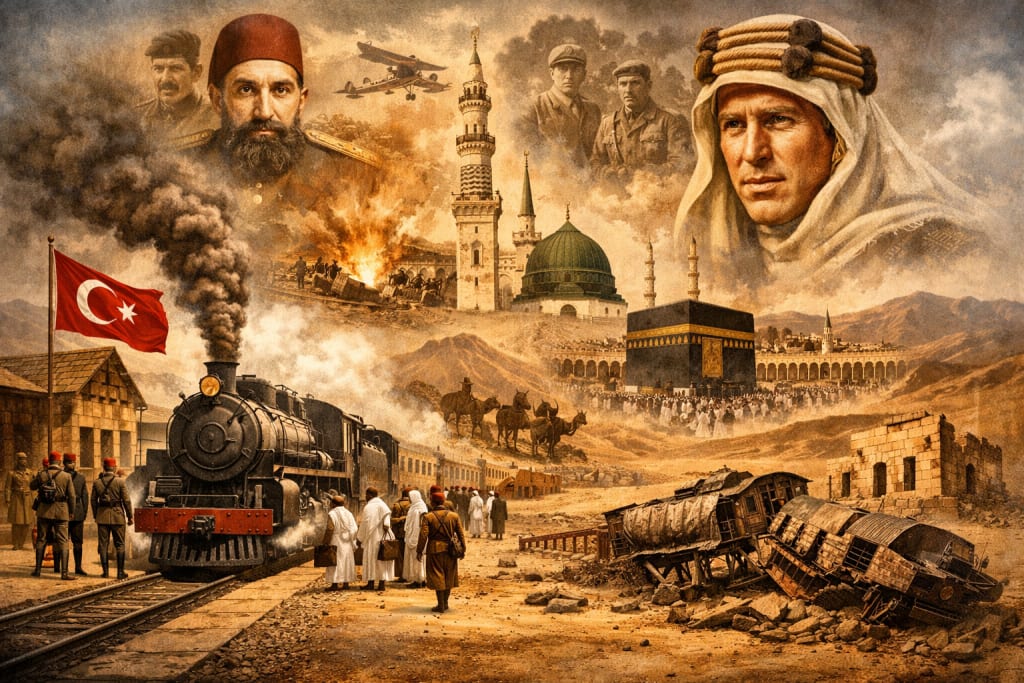
In the early twentieth century, the Ottoman Empire launched one of the most ambitious infrastructure projects in the Muslim world: the Hijaz Railway. Conceived as both a symbol of Islamic unity and a practical solution to improve travel for pilgrims heading to Mecca, the railway represented the Ottoman Sultan’s vision of connecting distant Muslim lands. Yet, despite its promise and initial success, the project was ultimately left abandoned due to war, rebellion, and the collapse of the empire itself.
The idea of the Hijaz Railway emerged during the reign of Abdul Hamid II, who ruled the Ottoman Empire from 1876 to 1909. At the time, the empire faced increasing political pressure from European powers and internal nationalist movements. To strengthen ties with Muslims across the empire and beyond, the Sultan promoted the concept of Islamic solidarity. The railway became one of the most visible expressions of this policy.
Construction of the Hijaz Railway officially began in 1900. Its goal was to connect Damascus with the holy cities of Medina and eventually Mecca. Before the railway, pilgrims traveling for Hajj often faced long, dangerous journeys across the desert that could take up to 40 days by camel caravan. The railway promised to reduce travel time to just a few days while providing safer and more reliable transportation.
One of the most remarkable aspects of the project was how it was funded. Rather than relying solely on state resources, the Ottoman government appealed to Muslims around the world for donations. Contributions flowed from communities in places as far away as India, North Africa, and Central Asia. The project thus became not only an engineering achievement but also a collective effort that symbolized the unity of the global Muslim community.
By 1908, the railway had reached Medina, covering approximately 1,300 kilometers. Stations, bridges, and telegraph lines were built across harsh desert landscapes. The project also demonstrated the empire’s ability to modernize using contemporary engineering techniques while maintaining its religious and political identity. However, the dream of extending the railway all the way to Mecca was never realized.
The decline of the railway began shortly after its completion to Medina. Political turmoil within the Ottoman Empire led to the deposition of Sultan Abdul Hamid II in 1909, weakening the central authority that had championed the project. Soon afterward, the outbreak of World War I dramatically altered the region’s political landscape.
During the war, the railway became a strategic military asset for the Ottomans, enabling them to transport troops and supplies across the Arabian Peninsula. This made it a key target during the Arab Revolt, which was supported by the British. Rebel forces frequently sabotaged the railway by blowing up tracks, bridges, and trains, severely disrupting its operations.
Among the figures associated with these attacks was T. E. Lawrence, who helped coordinate guerrilla operations against Ottoman supply lines. Continuous sabotage weakened the railway’s functionality and made maintenance increasingly difficult.
The final blow came with the defeat of the Ottoman Empire at the end of World War I. As the empire collapsed, its territories in the Middle East were divided among emerging states and European mandates. The railway line passed through several newly formed political boundaries, making unified administration nearly impossible.
Without a central authority to manage it and with many sections damaged during the war, large parts of the Hijaz Railway fell into disuse. While some segments in modern-day Syria and Jordan continued to operate on a limited scale, the grand vision of a continuous railway linking Damascus to Mecca was never revived.
Today, remnants of the railway—abandoned stations, rusting locomotives, and broken tracks—still stand across the desert as reminders of an ambitious project that once aimed to connect the Muslim world. The Hijaz Railway remains a powerful historical symbol: a reminder of both the Ottoman Empire’s final efforts to unite its people and the geopolitical forces that ultimately prevented that dream from being realized.
In retrospect, the Hijaz Railway was not merely a transportation project. It was a political, religious, and cultural initiative designed to reinforce solidarity among Muslims at a time when the Ottoman Empire was struggling to survive. Its failure reflects the broader decline of the empire and the dramatic transformations that reshaped the Middle East in the early twentieth century.
About the Creator
Irshad Abbasi
Ali ibn Abi Talib (RA) said 📚
“Knowledge is better than wealth, because knowledge protects you, while you have to protect wealth.
Keep reading
More stories from Irshad Abbasi and writers in History and other communities.
From Empire to Republic: The Rise and Fall of the Ottoman Superpower
For more than six centuries, the Ottoman Empire stood as one of the most powerful and influential states in world history. Stretching across three continents—Europe, Asia, and Africa—it controlled strategic trade routes, diverse populations, and some of the most important cities of the medieval and early modern world. Yet by the early twentieth century, this once-mighty empire collapsed, giving birth to the modern Republic of Turkey. The story of its rise and fall is one of military brilliance, political struggle, and dramatic reform.
By Irshad Abbasi about 7 hours ago in History
Unofficial Challenge: Black History Celebration
Forward: February 28th, 10:53 PM, EST... The final hour of Black History Month, 2026. Hello fellow writers. I've had this challenge waiting in my drafts for most of the month. But I held off on publishing it, until now.
By Sam Spinelli5 days ago in Writers


Comments
There are no comments for this story
Be the first to respond and start the conversation.