
The Partition of the Ottoman Empire: How Britain and France Reshaped the Middle East
A Century Ago, Secret Agreements and Oil Interests Redrew Borders and Planted the Seeds of Modern Conflicts

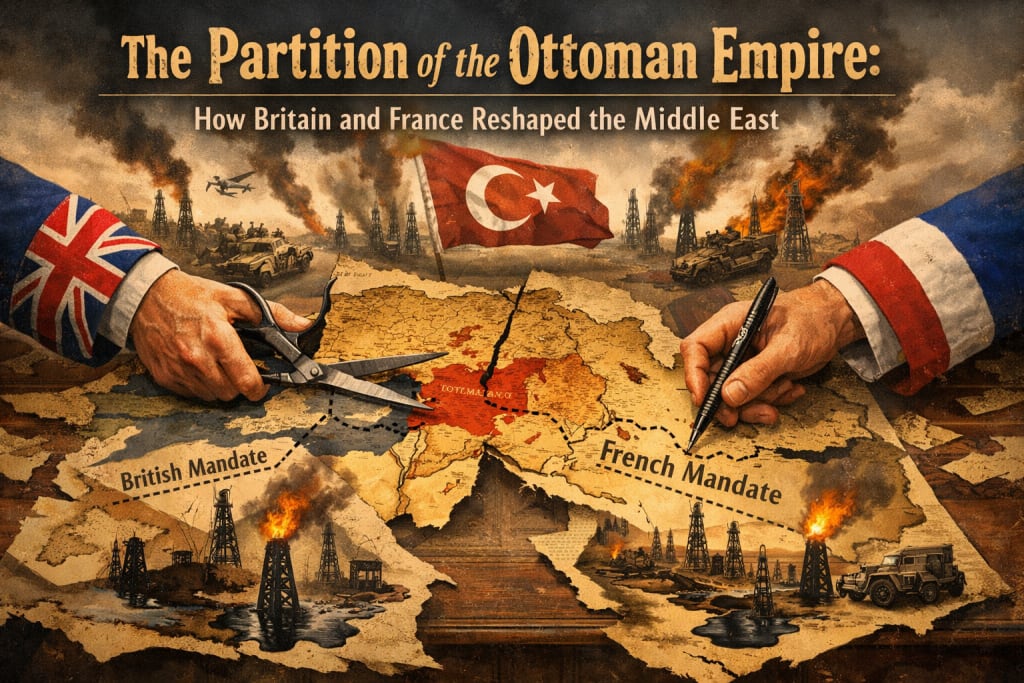
The collapse of the Ottoman Empire after World War I dramatically transformed the political map of the Middle East. For more than four centuries, the Ottoman Empire had ruled vast territories stretching across the Middle East, North Africa, and parts of Europe. However, by the early twentieth century, the empire had weakened politically, economically, and militarily. When the Ottomans joined Germany and the Central Powers in World War I, Britain and France saw an opportunity to reshape the region according to their own strategic and economic interests. The result was the partition of Ottoman lands, an event that still shapes Middle Eastern politics today.
One of the most significant steps toward dividing the Ottoman territories was the secret Sykes–Picot Agreement of 1916. Negotiated between Britain and France with the approval of Russia, this agreement outlined how the two European powers would divide large parts of the Middle East once the Ottoman Empire was defeated. Under this arrangement, France would control areas that later became Syria and Lebanon, while Britain would dominate territories that eventually became Iraq, Jordan, and Palestine. These borders were largely drawn without regard for the ethnic, tribal, or religious realities of the region.
Oil played a major role in shaping European ambitions in the Middle East. By the early twentieth century, oil had become an essential resource for modern warfare and industrial economies. The British Navy had already shifted from coal to oil, making access to petroleum supplies strategically vital. Iraq, particularly the region around Mosul, was believed to contain vast oil reserves. Britain therefore worked hard to ensure it gained influence over Iraq. Similarly, other regions of the Middle East were increasingly viewed not just as colonial territories but as potential sources of energy wealth.
The end of World War I in 1918 confirmed the defeat of the Ottoman Empire, and the Allied powers began implementing their plans. The San Remo Conference of 1920 formally established the mandate system under the newly formed League of Nations. Instead of outright colonies, the defeated Ottoman territories were placed under “mandates,” which allowed European powers to administer them temporarily until they were supposedly ready for independence. In practice, however, this system functioned very much like colonial rule.
Under the mandate system, France took control of Syria and Lebanon, while Britain administered Iraq and Palestine. The British also established the Emirate of Transjordan, which later became the modern state of Jordan. These new political entities were often created with little consideration for the historical and cultural complexities of the region. As a result, many borders cut across tribal lands and mixed communities, planting the seeds for future tensions and conflicts.
The partition of Ottoman lands also conflicted with promises Britain had made to Arab leaders during the war. In correspondence between British officials and Sharif Hussein of Mecca, the Arabs were encouraged to revolt against Ottoman rule with the expectation that they would gain independence afterward. The Arab Revolt (1916–1918), led by Hussein’s forces with British support, significantly weakened the Ottomans in the region. However, once the war ended, the Arab leaders realized that Britain and France had already planned to divide the territory between themselves.
Another controversial development during this period was the Balfour Declaration of 1917, in which Britain expressed support for the establishment of a “national home for the Jewish people” in Palestine. This policy later contributed to tensions between Jewish and Arab communities in the region, eventually leading to the long and complex Israeli–Palestinian conflict.
The legacy of these decisions continues to shape Middle Eastern politics today. Many historians argue that the artificial borders created by European powers contributed to instability, sectarian divisions, and conflicts that persist even a century later. Countries like Iraq and Syria have experienced political turmoil partly because their borders combined diverse ethnic and religious groups under single states without strong national cohesion.
Furthermore, control over oil resources remained a central factor in international involvement in the region throughout the twentieth century. Western powers maintained strong political and economic ties to Middle Eastern states in order to secure access to energy supplies.
In conclusion, the partition of the Ottoman Empire was not simply the end of an old empire; it was the beginning of a new geopolitical order in the Middle East. Through secret agreements, colonial mandates, and strategic control over oil resources, Britain and France reshaped the region according to their own interests. The borders and political arrangements created during that period continue to influence Middle Eastern conflicts and global politics even more than a hundred years later.
If you want, I can also create a powerful cover image for this article (for YouTube or a blog) showing the Ottoman map being divided by Britain and France with oil fields highlighted.
About the Creator
Irshad Abbasi
Ali ibn Abi Talib (RA) said 📚
“Knowledge is better than wealth, because knowledge protects you, while you have to protect wealth.
Keep reading
More stories from Irshad Abbasi and writers in History and other communities.
Selim I: The Ottoman Prince Who Ordered the Execution of His Own Family
In the long and dramatic history of the Ottoman Empire, few rulers are remembered as fiercely and controversially as Selim I, also known as Selim the Grim. Rising to power in 1512, Selim I transformed the Ottoman Empire into a dominant force in the Islamic world. Yet his reign began with a chilling series of executions that shocked even his contemporaries. To secure the throne, Selim reportedly ordered the deaths of his own brothers, nephews, and even some of his sons—an act that reflected the brutal political realities of the Ottoman dynasty.
By Irshad Abbasi about 20 hours ago in History
How Pluto was Discovered By Mistake
Pluto’s discovery wasn’t a planned success — it was actually the result of a mathematical mistake that shocked the world. Astronomers were searching billions of kilometers away for a powerful “cosmic predator” that seemed to be pulling planets out of their paths. But when they finally reached their target, they didn’t find a massive hunter — they found a tiny traveler.
By Imran Ali Shah6 days ago in History




Comments
There are no comments for this story
Be the first to respond and start the conversation.