
US jet fighter downed over Kuwait 'was UK-based
UK-Based F‑15E Among Jets Mistakenly Downed Over Kuwait in Friendly Fire Incident

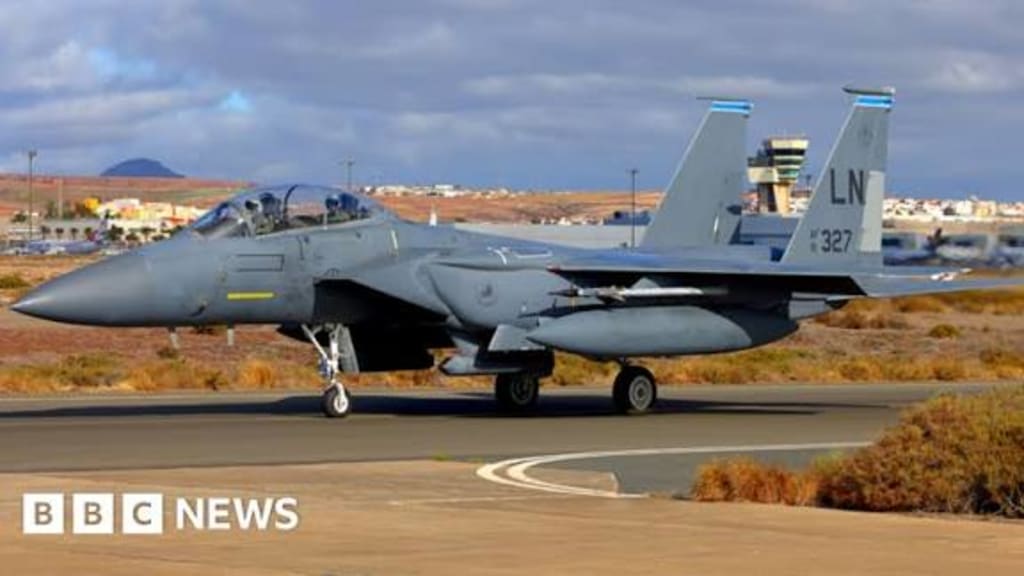
At least one of the United States Air Force fighter jets that was downed over Kuwaiti airspace in early March appears to have been based in the United Kingdom, according to emerging evidence from open‑source imagery and reconstruction by independent analysts. The revelation adds a new layer to an already sensitive and complex episode in the ongoing regional conflict involving the U.S., Iran, and allied forces.
The fighter jet in question was one of three U.S. F‑15E Strike Eagle aircraft that were mistakenly shot down over Kuwait on March 1, 2026, during what U.S. Central Command (CENTCOM) has characterized as an “apparent friendly fire incident” amid intense aerial operations. All six aircrew members ejected safely and were recovered in stable condition.
Initial statements from CENTCOM confirmed that the three F‑15Es — advanced multi‑role fighter bombers — were engaged in defensive and offensive missions against Iranian aircraft, ballistic missiles, and unmanned aerial systems when Kuwaiti air defenses mistakenly engaged them.
New Confirmation of UK Base Origin
A report published on March 7 cites analysis of video footage showing wreckage with a visible serial number. That serial number, 91‑0327 LN, corresponds to an F‑15E assigned to the 492nd Squadron of the 48th Fighter Wing, which is stationed at RAF Lakenheath in Suffolk, United Kingdom. Aviation analysts compared imagery from a recent training exercise with the wreckage, and identified matching markings on the jet’s wheel housing and distinctive colour patterns on the inner wheel hubs.
RAF Lakenheath did not directly confirm the identity of the aircraft, instead directing questions to U.S. Central Command. The United States Air Force has not publicly disclosed the complete list of F‑15E units deployed to the Middle East as part of Operation Epic Fury, the official name for the broader U.S. operational campaign in the region.
Open‑source aviation trackers and observers say that jets from multiple U.S. Air Force wings — including those based in North Carolina and Idaho — were also part of the deployment, which complicates the task of fully cataloguing the origins of every aircraft involved.
Sequence of Events Leading to Shootdowns
According to Reuters and U.S. military sources, the incident unfolded late on March 1 when three F‑15E jets were operating over Kuwait as part of coalition efforts against Iranian aerial threats. Kuwait’s air defense units, in a highly stressed and cluttered airspace environment, misidentified the American jets as hostile and engaged them with defensive weapons.
The chaos in the skies was attributed to a complex overlap of radar contacts, missiles, drones, and aircraft from multiple military forces involved in the conflict. Separately, Iranian strikes involving ballistic missiles and drones were targeting allied positions and infrastructure in the region, further heightening alert levels among Gulf air defenses.
All six U.S. aircrew members — typically a pilot and a weapon system officer aboard each F‑15E — successfully ejected and made controlled descents by parachute. News footage and witness accounts included images of parachutes descending over Kuwait’s Al Jahra area, followed by ground rescue efforts.
Diplomatic and Military Responses
Kuwait officially acknowledged the incident as a tragic mistake and expressed its cooperation with U.S. military authorities in the ensuing investigation. CENTCOM has emphasized that coalition forces are grateful for the support of Kuwaiti defense forces, even as both sides work to determine why airspace identification and de‑confliction protocols failed on this occasion.
There have been no reported fatalities from the shootdowns themselves, though separate Iranian strikes in Kuwait are believed to have caused U.S. military casualties in other incidents around the same time.
Operational and Strategic Impact
The loss of three F‑15E aircraft — each valued at tens of millions of dollars — represents a significant material setback for the U.S. Air Force, even if it did not result in loss of life. Analysts have noted that friendly fire incidents of this scale are rare, particularly when involving high‑performance air forces operating in coalition with integrated command systems.
Investigators are expected to examine a host of technical and procedural factors including radar identification systems, communication protocols between allied forces, and standard operating procedures for allied airspace coordination during high‑intensity combat.
As the broader regional conflict continues to unfold, the downing of U.S. jets — including at least one aircraft linked to a UK airbase — highlights the risks of miscommunication and misidentification in modern aerial warfare.
About the Creator
Fiaz Ahmed
I am Fiaz Ahmed. I am a passionate writer. I love covering trending topics and breaking news. With a sharp eye for what’s happening around the world, and crafts timely and engaging stories that keep readers informed and updated.
Keep reading
More stories from Fiaz Ahmed and writers in The Swamp and other communities.
China’s PBOC Extends Gold Buying as Middle East Tension Simmers
Amid escalating tensions in the Middle East, China’s People’s Bank of China (PBOC) has reportedly increased its gold reserves, signaling a cautious hedging strategy against geopolitical uncertainty and market volatility. Analysts suggest the move reflects Beijing’s effort to protect its financial stability while diversifying its foreign reserves beyond the U.S. dollar. The PBOC has quietly purchased significant amounts of gold over the past quarter, according to domestic and international sources tracking global bullion markets. China, already the world’s largest gold consumer, is taking advantage of recent dips in the yellow metal’s price to bolster its reserves. Some estimates indicate that these purchases could add tens of billions of dollars in value to Beijing’s holdings. The backdrop to this move is a surge in regional tensions, particularly involving Iran and neighboring Gulf states. Military escalation in the Persian Gulf and attacks on shipping lanes have created uncertainty in oil markets, prompting central banks worldwide to seek stability in alternative assets such as gold. “Gold remains a safe haven in times of geopolitical risk,” said Li Wen, a commodities analyst in Shanghai. “By increasing its holdings, China is hedging against currency fluctuations and potential disruptions in energy supplies.” China’s strategy is consistent with its long-term goal of diversifying reserves. While the U.S. dollar dominates global trade and reserve holdings, Beijing has gradually been shifting toward assets less exposed to external shocks. Gold provides a tangible store of value immune to political interference, making it an attractive option amid rising U.S.-Middle East tensions. The current wave of purchases also coincides with increased volatility in global energy markets. Iran, a major oil exporter, has become central to international concern following a series of attacks on commercial vessels and heightened military activity in the Gulf. Crude oil prices have fluctuated sharply in response to these developments, prompting financial institutions to reassess risk exposure. China relies heavily on Middle Eastern oil to fuel its growing economy, with imports from the Gulf making up a substantial portion of national demand. By bolstering gold reserves, the PBOC is indirectly insulating the economy from potential supply shocks or price spikes resulting from regional instability. International observers note that China’s gold buying is part of a broader trend among central banks seeking alternative reserves. In recent months, central banks from India, Russia, and other major economies have also increased gold purchases, citing similar concerns about geopolitical risks and financial market uncertainty. Despite the strategic significance, China has not publicly disclosed the full scale of its bullion acquisitions. PBOC statements emphasize the importance of maintaining diversified reserves while supporting domestic financial stability, avoiding commentary on specific geopolitical considerations. Analysts, however, argue that timing and scale strongly suggest the purchases are linked to the ongoing Middle East situation. The move has implications beyond Beijing’s balance sheet. Increased demand from central banks can influence global gold prices, which are already sensitive to currency fluctuations, interest rate expectations, and geopolitical developments. Markets have responded with slight upward pressure on bullion prices, reflecting investor sentiment regarding safety and liquidity. China’s extended gold accumulation reflects both financial prudence and geopolitical calculation. By hedging against potential shocks in global markets, the PBOC is signaling a cautious approach to international uncertainty, particularly in the oil-rich Middle East region. Observers believe this trend may continue if tensions escalate further, as gold remains a globally recognized hedge against risk. For Beijing, expanding its reserves is not only an economic safeguard but also a strategic tool, ensuring that China remains resilient in a volatile global landscape. With the Middle East crisis showing no immediate signs of de-escalation, China’s PBOC is likely to maintain, if not accelerate, its gold purchases, securing an asset that has historically proven its value in times of uncertainty and geopolitical unrest.
By Fiaz Ahmed about 7 hours ago in The Swamp
A Gathering of Evil Bosses
“I’m the queen of chin jutting while I smooth my hair, attacking, insulting, and deflecting to protect my appointer.” “Oh, please, Blondi, my hair is curled, highlighted, and longer than yours. I feature television commercials telling immigrants that we will give them a free plane ride home, and if they voluntarily turn themselves in, they will be allowed to legally apply for re-entry. It runs everywhere, and I look good in it! You can’t compete because of your blond hair. Mine is nicer, and my lips are prettier than yours.”
By Andrea Corwin 17 days ago in The Swamp
The First Casualty Of War Is The Truth
It is often said that in times of war, the first casualty is the truth. When Donald Trump launched Operation Epic Fury, he said that the goal was to stop Iran from developing nuclear weapons. At the same time, when the head of the International Atomic Energy Agency (IAEA), Rafael Grossi, was asked about it, he said that they do not even have access to the sites. Therefore, they have no clear idea about what is happening there, and he appeared somewhat confused.
By Ibrahim Shah about 8 hours ago in The Swamp




Comments
There are no comments for this story
Be the first to respond and start the conversation.