fintech
A foray into fintech; a breakdown of the latest and greatest innovations in financial technology.
Philippines Digital Payments Market: Fintech Adoption, Financial Inclusion & Cashless Transition. AI-Generated.
Philippines Digital Payments Market Overview The Philippines digital payments market growth is expanding rapidly as consumers, businesses and government institutions adopt electronic transaction methods to improve convenience, efficiency and financial inclusion. Digital payments encompass mobile wallets, online banking transfers, card-based transactions, QR code payments and peer-to-peer platforms. These solutions are gradually reducing reliance on cash and reshaping how money moves across the economy. The Philippines digital payments market size reached USD 616.3 Million in 2025. Looking forward, the market is expected to reach USD 1,867.6 Million by 2034, exhibiting a growth rate (CAGR) of 13.11% during 2026-2034. This strong growth reflects rising smartphone usage, expanding internet connectivity and supportive regulatory frameworks.
By Manisha Dixitabout a month ago in Trader
Exploring Divexa’s Technical Infrastructure in Modern Finance. AI-Generated.
In the rapidly evolving landscape of financial technology, technological innovation remains the cornerstone of industry transformation. Divexa, while often recognized for its broad financial services offerings, plays a crucial role in shaping the technical infrastructure and operational methodologies of modern fintech. By leveraging advanced computing frameworks, decentralized protocols, and data-driven analytics, Divexa exemplifies how technology can drive efficiency, scalability, and enhanced user experiences in financial systems.
By Divexa Exchangeabout a month ago in Trader
Bitcoin Stands Alone as Liquidity Dries Up
Bitcoin suffered a sharp and unusually persistent sell-off between the night of the 29th and the morning of the 30th, falling from approximately $87,000 to $81,000 in less than twelve hours, a decline of nearly 7 percent. While risk assets across the broader crypto market weakened in tandem, what stood out was not the magnitude of the drop itself but Bitcoin’s inability to recover alongside traditional markets. Equities and commodities attempted modest rebounds after the initial shock, yet Bitcoin remained pinned near the lows. This divergence offers a clearer window into the current state of market liquidity than any single headline catalyst.
By crypto genieabout a month ago in Trader
Is the Dollar Losing Its Global Power?
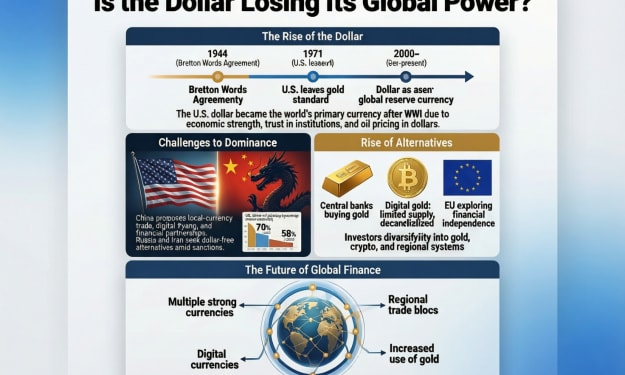
Is the Dollar Losing Its Global Power? For many decades, the U.S. dollar has been the most powerful currency in the world. It has been used for global trade, oil sales, international loans, and foreign reserves. Countries trusted the dollar as a safe store of value. But today, many experts are asking an important question: Is the dollar entering its last strong phase?
By Wings of Time about a month ago in Trader
Institutional Staking Maturity: A VQJ Exchange Review of Bitmine’s Ether Holdings. AI-Generated.
The cryptocurrency sector is undergoing a fundamental structural change. For years, the industry’s rhythm was dictated by volatile price cycles—booms fueled by hype and busts driven by panic. However, a quieter, more sustainable transformation is taking place in the background. Bitmine, a major player in the digital asset space, recently released its annual figures regarding Staked Ether holdings. The report reveals a significant revenue stream derived entirely from network validation rewards. This is not profit from trading or speculation; it is income generated by productive capital.
By VQJ Exchangeabout a month ago in Trader
Bitcoin Price: A Complete Guide to Understanding Market Movements
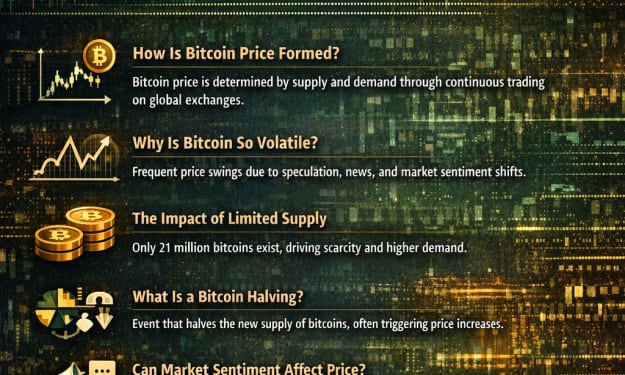
**Bitcoin Price: A Complete Guide to Understanding Market Movements** Bitcoin is the most widely recognized digital currency in the world and one of the most actively discussed financial assets in modern markets. Since its creation, Bitcoin price has attracted massive attention due to its rapid growth, sharp volatility, and decentralized nature. Unlike traditional currencies issued by governments, Bitcoin operates on a peer-to-peer network, which means its price is determined entirely by market forces rather than central authority decisions.
By America today about a month ago in Trader
Philippines AI in Fintech Market: Intelligent Finance, Digital Growth & Risk Innovation. AI-Generated.
Philippines AI in Fintech Market Overview The Philippines AI in fintech market is rapidly gaining momentum as financial institutions, digital payment platforms and emerging fintech startups adopt artificial intelligence (AI) technologies to enhance service delivery, operational efficiency and customer experience. AI in fintech covers a range of intelligent systems including machine learning models, virtual assistants, fraud detection tools, behavioural analytics and credit scoring systems that optimise decision-making and reduce risks. The Philippines AI in fintech market size reached USD 79.38 Million in 2024. The market is projected to reach USD 419.35 Million by 2033, exhibiting a growth rate (CAGR) of 18.11% during 2025-2033 as AI becomes integral to financial innovation and digital transformation across banking, payments and financial services.
By Manisha Dixitabout a month ago in Trader
El Salvador’s Unconventional Bet
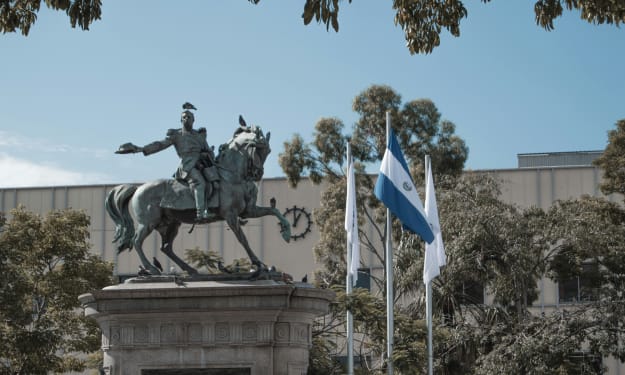
As global financial markets grow increasingly unstable, El Salvador is once again taking a path few nations are willing to follow. The country is not only expanding its gold reserves but also continuing its daily accumulation of Bitcoin. This dual approach reflects more than an investment decision. It signals a broader reassessment of how a small, dollar-dependent economy prepares for systemic risk in a changing global order.
By crypto genieabout a month ago in Trader
Why South Korea Fintech Market Is Becoming Essential in Everyday Life. AI-Generated.
How Fintech Is Quietly Changing the Way South Koreans Handle Money If you visit South Korea today, you’ll notice something interesting about the way people pay for things. Many don’t carry wallets. Instead, they tap their phones, scan QR codes, or use biometric authentication to complete transactions within seconds.
By Kim Soo hyunabout a month ago in Trader