
Peter J. Carroll
Radical Occult Thinker and the Emergence of Chaos Magic

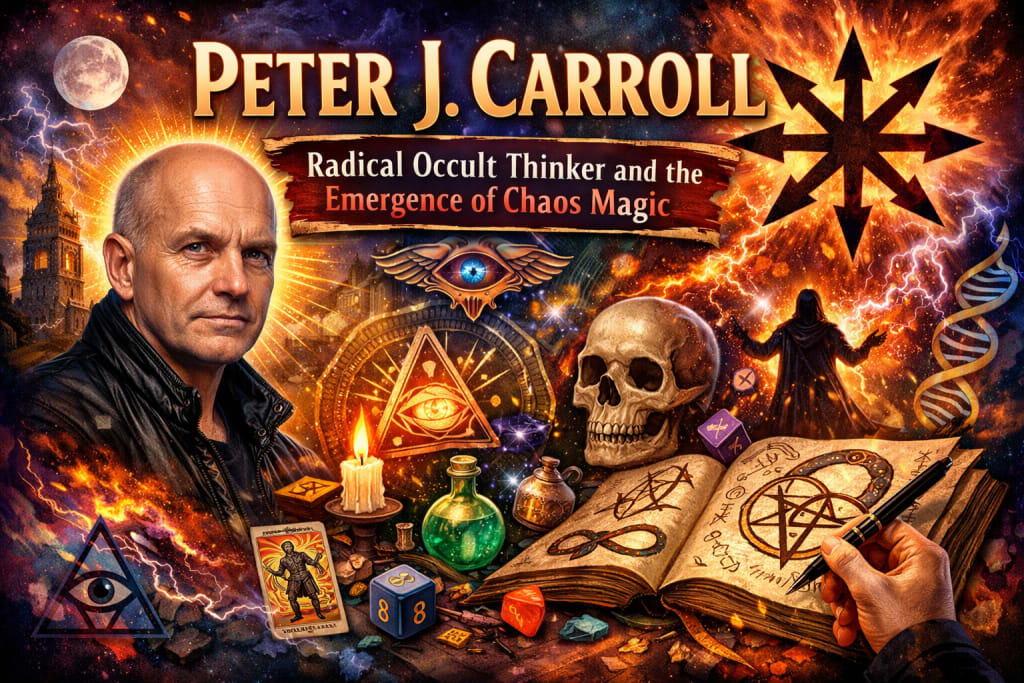
The Emergence of Chaos Magic and the Influence of Peter J. Carroll
The closing decades of the twentieth century witnessed a notable transformation within Western occult thought. Ceremonial traditions rooted in nineteenth century esoteric orders continued to influence magical practice, yet growing dissatisfaction with rigid doctrine encouraged new approaches. Within experimental occult circles in Britain and Europe, discussion increasingly focused on results, psychology, and personal experience rather than inherited authority. From that environment emerged chaos magic, a current that challenged long established assumptions about ritual, belief, and the nature of magical practice.
Among the most visible figures associated with that transformation stands Peter J. Carroll, a British occult writer and theorist whose ideas reshaped modern magical discourse. During the late 1970s Carroll began presenting a radical perspective that treated magic as a practical discipline built upon experimentation rather than tradition. Carroll’s early writings circulated through small press publications and underground occult networks before gaining wider recognition through influential works such as Liber Null and Psychonaut. Within those texts Carroll outlined a system that placed emphasis on altered states of consciousness, disciplined mental training, and deliberate manipulation of belief.
Central to Carroll’s philosophy stood the concept that belief could function as a temporary tool rather than a permanent doctrine. Traditional magical systems often required strict adherence to symbolic structures derived from Hermeticism, Kabbalah, astrology, or ceremonial ritual. Carroll proposed an alternative method in which symbolic frameworks could be adopted, modified, or discarded according to practical effectiveness. Such flexibility opened the door for practitioners to experiment with diverse mythologies, psychological models, and artistic symbolism without the constraints of fixed dogma.
Historical development of chaos magic also involved collaboration and organizational activity. During the late 1970s Carroll worked alongside occult writer Ray Sherwin to help establish the Illuminates of Thanateros, an initiatory magical order dedicated to experimental practice and the exchange of practical techniques. Through ritual work, publications, and private instruction, members of that order contributed to the early structure of the emerging chaos magic movement. Discussion within those circles explored sigilization, gnosis, altered perception, and the role of belief in magical effectiveness.
Carroll’s theoretical proposals quickly generated both fascination and controversy. Admirers within modern occult communities regarded Carroll as a reformer whose work revived practical experimentation in a field sometimes constrained by historical imitation. Skeptics questioned ambitious attempts to relate magical theory to concepts drawn from mathematics, physics, and cosmology. Debate surrounding Carroll’s ideas continued for decades, yet widespread discussion itself revealed significant cultural impact.
By the end of the twentieth century, chaos magic had spread far beyond original underground networks. Independent occult publishers, experimental magical groups, and later digital communities helped circulate Carroll’s writings across Europe, North America, and other regions interested in contemporary esotericism. Within that expanding landscape, the name Peter J. Carroll became closely associated with a movement that encouraged intellectual curiosity, disciplined experimentation, and the creative reinterpretation of magical symbolism.
Foundations of a Radical Magical Thinker
Peter James Carroll entered the world in 1953 in England during a period marked by accelerating scientific discovery and cultural change. Mid twentieth century Britain stood at the intersection of tradition and innovation. Advances in nuclear physics, space exploration, psychology, and computing reshaped intellectual life across Europe and North America. Scientific optimism, combined with widespread questioning of established institutions, created an atmosphere in which unconventional ideas about consciousness, reality, and human potential could emerge. Within that historical climate, the formative years of Peter J. Carroll unfolded.
Educational development moved toward the sciences at an early stage. University study centered on chemistry and related scientific disciplines. Training within laboratory environments required careful observation, logical reasoning, and precise experimentation. Scientific methodology emphasized hypothesis, testing, and measurable outcomes. Exposure to such principles later influenced Carroll’s approach to magical theory. Many later writings adopted analytical language that resembled experimental philosophy or scientific inquiry rather than traditional mystical instruction.
Professional life began within the field of education. Employment as a science teacher required the communication of complex concepts in clear and structured ways. Classroom instruction demanded intellectual discipline as well as the ability to translate abstract theory into understandable practice. Experience gained through teaching contributed to the distinctive tone found in Carroll’s later books. Magical exercises often appeared in organized sequences that resembled laboratory procedures or structured mental training.
Curiosity about consciousness and human perception gradually extended beyond conventional scientific frameworks. Interest in mystical traditions, altered states of awareness, and philosophical speculation developed during early adulthood. Questions surrounding the limits of rational knowledge and the possibility of expanded perception encouraged exploration outside academic institutions.
Travel played a meaningful role in that intellectual expansion. Extended journeys across regions of Asia exposed Carroll to philosophical traditions that differed dramatically from Western rationalism. Encounters with meditation practices, ascetic disciplines, and mystical systems of thought offered new perspectives on the relationship between mind, belief, and perception. Exposure to Buddhist contemplative practices and other forms of Eastern spirituality introduced methods designed to alter awareness through concentration, ritualized breathing, and disciplined introspection. Such encounters reinforced interest in techniques capable of transforming mental states.
Return to Britain during the early 1970s brought Carroll into contact with a lively network of occult enthusiasts and experimental thinkers. Urban centers such as London hosted a variety of small magical groups, alternative bookstores, and independent publishing efforts devoted to esoteric subjects. Underground magazines circulated discussions of ritual magic, psychic experimentation, and philosophical speculation about consciousness. Cultural influence from the countercultural movements of the 1960s continued to shape those communities, encouraging skepticism toward rigid authority and enthusiasm for intellectual exploration.
Within that environment Carroll encountered individuals interested in practical experimentation rather than strict adherence to inherited ceremonial traditions. Conversations within occult discussion groups often revolved around the effectiveness of magical techniques rather than loyalty to specific symbolic systems. Such discussions gradually contributed to the emergence of a new philosophy of magic built upon flexibility, experimentation, and psychological exploration. The intellectual groundwork for what would later become known as chaos magic began to take form within those unconventional circles.
A Time of Experimentation in Western Occult Thought
The emergence of chaos magic cannot be separated from the cultural atmosphere that shaped occult practice during the 1970s. Western esotericism entered that decade after more than a century of revival, reinvention, and debate. Nineteenth century occult orders such as the Hermetic Order of the Golden Dawn had introduced elaborate ceremonial systems rooted in Hermetic philosophy, Kabbalistic symbolism, astrology, and ritual magic. Twentieth century figures including Aleister Crowley expanded those traditions through new philosophical frameworks and personal magical systems. By the middle of the twentieth century, ceremonial magic, witchcraft traditions, and mystical philosophy had all gained a renewed presence within Western spiritual culture.
Despite that revival, dissatisfaction grew among younger practitioners who encountered complex hierarchies, dense symbolic structures, and rigid ritual procedures within established magical traditions. Many occult organizations required lengthy study of intricate correspondences and adherence to strict initiatory grades. Ritual practice often relied upon symbolism inherited from earlier esoteric movements rather than direct experimentation. For a growing number of occult thinkers, such structures appeared distant from practical experience and creative exploration.
Several powerful cultural forces contributed to that shifting perspective. The social upheavals of the 1960s reshaped intellectual life throughout Europe and North America. Student movements, artistic revolutions, and widespread questioning of political authority fostered a climate in which inherited institutions faced critical scrutiny. Creative communities celebrated improvisation, experimentation, and personal expression. Music, literature, and visual art explored unconventional forms and rejected rigid tradition. Within that environment, spiritual exploration also moved toward more experimental paths.
Psychology played an equally significant role in reshaping occult discussion. Twentieth century thinkers such as Carl Jung had already introduced the concept that mythic symbols and religious imagery might emerge from deep layers of the human psyche. Interest in dream analysis, archetypes, and subconscious processes encouraged many occult practitioners to reconsider magical symbolism as psychological language rather than literal supernatural structure. Such ideas created space for new interpretations of ritual practice and mystical experience.
During the same period, Western audiences developed growing fascination with Asian philosophical traditions. Buddhist meditation, Hindu yogic systems, and Taoist philosophy attracted scholars, spiritual seekers, and artists interested in methods of mental discipline and expanded awareness. Meditation centers appeared throughout Europe and North America. Translations of ancient philosophical texts circulated widely among readers curious about contemplative traditions that approached consciousness through direct practice rather than theological doctrine.
Scientific and cultural discussion of altered states of consciousness further influenced the intellectual climate of the era. Research into psychedelic compounds during the 1950s and early 1960s had sparked debates about perception, consciousness, and the limits of human awareness. Although legal restrictions eventually curtailed formal experimentation, public fascination with altered perception continued within artistic and philosophical circles. Writers and researchers explored trance, meditation, sensory deprivation, and other methods capable of shifting mental states.
Within occult communities these developments encouraged a reconsideration of magical technique. Growing numbers of practitioners began questioning whether traditional ritual systems represented the only effective approach to magical practice. Interest shifted toward methods that emphasized psychological transformation, personal experimentation, and direct experience of altered consciousness.
Small independent occult groups, experimental discussion circles, and underground publications began sharing ideas that diverged sharply from ceremonial orthodoxy. Conversations within those circles explored new ritual structures, symbolic improvisation, and the possibility that belief itself could function as a deliberate tool. From that climate of questioning and experimentation emerged a radically flexible approach to magical practice that eventually came to be known as chaos magic.
The Emergence of Chaos Magic as a New Magical Philosophy
During the closing years of the 1970s a new current of occult thought began to crystallize within small experimental circles in Britain. Conversations among independent occult writers, ritual experimenters, and underground publishers gradually produced a philosophy that challenged the assumptions of traditional ceremonial magic. Out of that environment emerged a movement that would later become widely known as chaos magic.
Development of that philosophy occurred through collaboration rather than the work of a single individual. Among the most important figures involved in the early stages of the movement stood Peter J. Carroll and Ray Sherwin. Sherwin operated within the underground publishing world as editor of an independent occult magazine that circulated among experimental practitioners. That publication served as a forum where unconventional magical ideas could be exchanged outside the formal structures of established esoteric orders. Essays, letters, and theoretical discussions appearing within those pages allowed a small network of thinkers to explore new approaches to ritual and magical philosophy.
Discussion within those circles gradually moved toward a radical proposition. Magical practice, according to emerging theory, did not require permanent allegiance to a single symbolic tradition. Hermetic ritual, Kabbalistic correspondences, astrological symbolism, and mythological frameworks had long provided structure for ceremonial magic. Yet experimental practitioners increasingly questioned whether those inherited systems represented universal laws or simply cultural frameworks that shaped belief and expectation.
From that line of inquiry arose the philosophical foundation of chaos magic. Within that approach, magical effectiveness depended less upon loyalty to historical systems and more upon the deliberate manipulation of belief, attention, and psychological intensity. Ritual practice became a laboratory for mental experimentation rather than a reenactment of ancient symbolism.
One of the most distinctive principles involved the treatment of belief as a temporary instrument. Instead of permanent adherence to a specific magical worldview, practitioners could intentionally adopt a belief system for the duration of ritual activity. A mythological framework, religious image, or symbolic language could function as a psychological catalyst designed to focus concentration and emotional energy. Once ritual work concluded, belief could be set aside or replaced with an entirely different symbolic structure.
Such flexibility opened the door to an unprecedented range of magical symbolism. Chaos magic practitioners began drawing material from mythology, religious iconography, literature, art, and modern popular culture. Ancient deities, fictional characters, abstract symbols, and personal imagery all became possible components of ritual practice. The emphasis shifted toward effectiveness within altered states of consciousness rather than historical authenticity.
Techniques designed to generate intense mental focus soon became central to the emerging system. Methods capable of producing deep concentration or emotional intensity received particular attention. Meditation, rhythmic breathing, sensory overload, exhaustion, ecstatic movement, and focused visualization all served as potential gateways into states of awareness in which symbolic imagery could exert powerful influence upon perception and intention. Within chaos magic terminology such states later became associated with the concept of gnosis, a condition of concentrated awareness believed to facilitate magical action.
Organizational activity also contributed to the early development of the movement. During the late 1970s Peter J. Carroll and Ray Sherwin helped establish the Illuminates of Thanateros, a magical order dedicated to experimentation and the practical exchange of techniques. The organization combined ritual practice with theoretical exploration, encouraging members to test ideas rather than simply accept inherited doctrine. Through meetings, correspondence, and published writings, discussions within that order helped refine the emerging philosophy of chaos magic.
Written works played a decisive role in bringing those ideas beyond small occult circles. Peter J. Carroll eventually articulated the principles of chaos magic in influential texts that circulated among readers interested in alternative approaches to magical practice. Clear explanations of sigilization, altered consciousness, and the strategic use of belief helped introduce the philosophy to a much broader audience.
By the early 1980s chaos magic had begun to attract attention far beyond the underground networks in which the movement first appeared. Independent publishers, occult bookstores, and discussion groups carried those ideas into a wider world of spiritual experimentation. A philosophy that began as a series of discussions among a handful of experimental occultists had developed into one of the most influential movements in modern magical thought.
The Illuminates of Thanateros and the Structure of an Experimental Order
During the formative years of chaos magic, a small group of experimental occultists recognized the need for collaboration and organized exchange. Informal discussion circles and underground publications had already allowed ideas to circulate, yet practical experimentation required a network capable of sharing techniques, testing ritual methods, and refining theory through collective experience. Out of that desire for organized experimentation emerged the Illuminates of Thanateros, commonly abbreviated as the IOT.
Creation of the order took place during the late 1970s through cooperation between Peter J. Carroll, Ray Sherwin, and several associates active within the emerging chaos magic community. The name Illuminates of Thanateros reflected symbolic concepts drawn from classical mythology and psychology. The term Thanatos referred to the ancient Greek personification of death, while Eros symbolized desire, attraction, and creative vitality. Within the philosophical language of the organization, those two forces represented powerful drives that shape human behavior and imagination. Ritual exploration within the order often sought to harness emotional intensity and focused intention connected with those psychological forces.
Unlike many earlier occult societies, the Illuminates of Thanateros developed with a strong emphasis on practical results rather than elaborate ceremonial hierarchy. Members approached magical work as a form of disciplined experimentation. Ritual practice, meditation techniques, sigil methods, and altered states of consciousness formed the core of training within the organization. Communication among members encouraged the sharing of successful techniques as well as honest discussion of failed experiments.
Structural elements did exist within the organization, including initiation stages intended to mark progress in magical training. Those stages provided a framework through which practitioners could demonstrate understanding of chaos magic methods and philosophical concepts. Despite the presence of organizational structure, the ideological foundation of chaos magic strongly favored individual interpretation and creative experimentation. Each practitioner retained freedom to explore unique symbolic systems, ritual forms, and philosophical perspectives.
Growth of the Illuminates of Thanateros occurred gradually as interest in chaos magic expanded. Small temples, study circles, and informal training groups appeared across several regions of Europe. Over time new branches also emerged in North America and other parts of the world where modern occult communities had begun to flourish. Independent publishers and occult periodicals helped spread awareness of the organization, introducing chaos magic ideas to readers curious about unconventional approaches to ritual practice.
Through correspondence, private gatherings, and published writing, the Illuminates of Thanateros served as an early laboratory for chaos magic philosophy. Many techniques later associated with the movement received systematic testing within that community. Although chaos magic eventually spread far beyond the boundaries of the organization, the early role of the IOT proved crucial in shaping both the practice and the identity of the emerging movement.
Central Philosophical Principles of Chaos Magic
The writings of Peter J. Carroll introduced a set of theoretical ideas that became widely associated with chaos magic. These concepts did not function as rigid doctrine but rather as working models designed to guide experimentation with consciousness, symbolism, and ritual technique. Several of those ideas became especially influential within modern magical practice.
Belief as a Deliberate Instrument
Most religious traditions and many historical magical systems depend upon stable and enduring belief structures. Ceremonial magic, for example, often requires long term study of symbolic correspondences tied to a specific cosmological framework. Chaos magic introduced a dramatically different perspective.
Within chaos magic philosophy, belief operates as a flexible psychological instrument rather than a permanent commitment. A practitioner may adopt a particular symbolic system for the purpose of ritual concentration and emotional engagement. During ritual activity that belief functions as if completely real. Once the ritual concludes, the belief system can be set aside or replaced with an entirely different framework.
This deliberate manipulation of belief allows access to a wide range of mental states. Symbolic systems drawn from mythology, religion, art, fiction, or personal imagination may all serve as temporary ritual languages. The effectiveness of the system depends not upon historical authenticity but upon the ability to focus attention and stimulate emotional intensity.
Gnosis and the Power of Altered Awareness
A central concept within chaos magic involves the cultivation of intense states of focused awareness known as gnosis. In ordinary mental activity, continuous streams of internal dialogue and sensory distraction dominate conscious attention. Chaos magic theory proposes that magical intention becomes more effective when those distractions diminish and concentration reaches an unusually intense level.
Gnosis describes a mental condition characterized by silence of internal chatter and heightened focus upon a single idea or symbol. Several methods may lead to such a condition. Deep meditation can gradually quiet mental activity until awareness becomes sharply concentrated. Rhythmic movement, ecstatic dance, controlled breathing, or prolonged chanting may also produce trance like states in which attention narrows dramatically. In some cases emotional intensity, sensory overload, or even extreme exhaustion can produce similar effects.
Within chaos magic practice, ritual actions often aim to bring consciousness into that concentrated condition. When intention, symbolism, and emotional energy converge within such a state, practitioners believe that subconscious processes become more responsive to the implanted idea.
Sigil Creation and Symbolic Intention
One of the most recognizable techniques associated with chaos magic involves the creation of sigils. A sigil functions as a symbolic representation of a specific intention or desire. The method begins with a written statement describing a goal or desired outcome. Letters from that statement are then rearranged, condensed, and stylized until the phrase transforms into a unique abstract symbol.
During ritual practice the sigil becomes the focal point of intense concentration. Visual attention, emotional energy, and altered awareness combine to charge the symbol with meaning and intent. Once ritual charging concludes, the sigil is often destroyed, hidden, or deliberately forgotten.
Chaos magic theory proposes that removal of conscious attention allows subconscious processes to continue working without interference from doubt or anxiety. The symbolic intention embedded within the sigil remains active beneath ordinary awareness.
Although sigil techniques existed earlier in the work of the British artist and occult thinker Austin Osman Spare, the writings of Peter J. Carroll introduced the method to a much broader audience. Clear explanations and practical exercises helped transform sigil magic into one of the most widely practiced techniques within contemporary occultism.
The Concepts of Kia and Chaos
Peter J. Carroll also introduced philosophical terminology intended to describe the deeper structure of consciousness and existence. Two concepts in particular appear frequently within chaos magic literature: Kia and Chaos.
Kia represents the fundamental core of awareness that exists beneath personal identity, memory, and social conditioning. In chaos magic philosophy, Kia symbolizes pure consciousness itself. Individual personality and perception arise as temporary expressions of that deeper awareness.
Chaos refers to the limitless creative principle responsible for the continual emergence of phenomena throughout the universe. Rather than representing disorder, the term functions as a symbolic description of the boundless generative process underlying reality. Within that philosophical language, all forms, events, and experiences arise from the dynamic interplay of Chaos and consciousness.
Interpretation of those concepts varies widely among practitioners. Some readers approach the terminology as metaphysical description, while others treat the language as poetic metaphor designed to stimulate philosophical reflection. Regardless of interpretation, the ideas of Kia and Chaos helped provide a symbolic framework through which chaos magic practitioners could explore questions about consciousness, creativity, and the mysterious forces that shape human experience.
Intellectual Currents Behind the Rise of Chaos Magic
No philosophical movement appears in complete isolation. The emergence of chaos magic resulted from a convergence of earlier occult traditions, psychological insights, and experimental ideas circulating through late twentieth century counterculture. Peter J. Carroll drew from several intellectual streams that had already begun reshaping discussions of consciousness, symbolism, and belief. When combined with an experimental approach to magical practice, those influences helped produce one of the most distinctive philosophical frameworks in modern occultism.
Among the most significant early influences stood the work of the English artist and occult thinker Austin Osman Spare. Active during the early decades of the twentieth century, Spare developed an unconventional approach to magical practice that diverged sharply from the ceremonial systems of contemporary occult societies. Rather than emphasizing elaborate ritual structures, Spare focused on the psychological relationship between desire, symbolism, and the subconscious mind.
Spare introduced the idea that symbols created directly from personal intention could serve as powerful instruments of magical influence. A written statement of desire could be condensed into a unique visual form, producing a sigil designed to bypass ordinary conscious resistance. Through trance states, intense concentration, or emotional release, the symbol could be implanted into the deeper layers of the mind. Spare believed that subconscious processes might then influence behavior, perception, and circumstances in subtle but meaningful ways.
Although Spare’s work remained relatively obscure for several decades, rediscovery of those ideas during the late twentieth century provided fertile ground for the development of chaos magic techniques. Carroll and other experimental practitioners recognized that Spare’s emphasis on personal symbolism and subconscious influence aligned closely with emerging ideas about flexible belief and psychological experimentation.
Developments within modern psychology also contributed to the intellectual environment surrounding chaos magic. Twentieth century psychological research had already begun exploring the complex relationship between belief, perception, and behavior. Studies involving conditioning, suggestion, and altered states of awareness demonstrated that human perception does not operate as a passive reflection of external reality. Expectations, beliefs, and emotional states all play powerful roles in shaping experience.
Within occult communities, such insights encouraged a shift away from literal interpretations of magical cosmology. Magical symbolism could instead be viewed as a psychological language capable of directing attention and influencing subconscious processes. Ritual activity became less about invoking external supernatural forces and more about restructuring patterns of thought and perception.
Interest in altered states of consciousness further reinforced that perspective. Meditation practices, trance induction, hypnotic techniques, and ecstatic ritual methods all suggested that consciousness exists along a spectrum rather than within a fixed condition of awareness. When attention becomes intensely focused or when ordinary mental dialogue falls silent, unusual experiences may arise that transform perception of self and environment. Chaos magic practitioners recognized those altered states as potential gateways through which symbolic intention might operate more effectively.
Late twentieth century countercultural literature also played an important role in shaping the conceptual language surrounding chaos magic. Writers exploring philosophy, psychology, and experimental spirituality introduced ideas concerning subjective perception and the flexibility of belief systems. One widely discussed concept involved the notion of "reality tunnels," a term describing the tendency of human beings to interpret experience through mental frameworks shaped by culture, education, and personal belief. According to that perspective, different belief structures can produce dramatically different interpretations of the same events.
Such ideas resonated strongly within experimental occult circles. If perception depends partly upon belief, deliberate shifts in belief might produce equally significant changes in experience. Chaos magic philosophy embraced that possibility by encouraging practitioners to treat belief as a variable rather than a permanent identity.
Additional inspiration emerged from the broader artistic and philosophical experimentation of the late twentieth century. Avant garde literature, surrealist art, and experimental performance frequently challenged conventional distinctions between imagination and reality. Symbolism drawn from mythology, dreams, and abstract imagery appeared throughout creative movements that sought to expand human perception beyond ordinary categories. Within that creative landscape, chaos magic adopted a similar spirit of exploration.
The intellectual synthesis produced by those influences resulted in a magical philosophy unlike earlier ceremonial traditions. Personal symbolism from the work of Austin Osman Spare, psychological insights about belief and perception, and countercultural discussions of subjective reality all contributed essential elements. Peter J. Carroll’s writings brought those diverse ideas together into a coherent framework centered on experimentation, adaptability, and disciplined exploration of consciousness.
Debate, Disagreement, and the Contested Reputation of Chaos Magic
Few influential figures within modern occultism have escaped criticism, and the writings of Peter J. Carroll provoked substantial debate within both occult and academic circles. The unconventional character of chaos magic philosophy challenged many established assumptions about ritual practice, symbolism, and the nature of belief. As a result, Carroll’s work attracted both admiration and skepticism from readers attempting to evaluate the claims associated with the emerging movement.
One recurring point of controversy involved the relationship between magical theory and modern science. Carroll’s writings occasionally incorporated terminology drawn from physics, probability theory, and cosmology. Concepts associated with quantum uncertainty, mathematical chaos, and nonlinear systems appeared within several discussions of magical possibility and universal creativity. In those contexts scientific language served as a metaphorical framework intended to suggest that reality might contain deeper layers of complexity beyond ordinary perception.
Critics frequently argued that such references blurred the distinction between metaphor and scientific explanation. Physicists and scientifically trained readers sometimes pointed out that ideas from quantum mechanics or cosmological theory cannot easily be applied to human intention or ritual symbolism. From that perspective, scientific terminology within magical literature risked creating confusion by implying empirical support where none existed. Supporters of Carroll’s work often responded that those references functioned primarily as philosophical illustrations rather than literal claims about physical mechanisms.
Another area of debate concerned the fundamental interpretation of chaos magic itself. Within the community of practitioners, two broad perspectives gradually emerged. One approach treated chaos magic as a psychological discipline focused on influencing perception, emotion, and behavior through symbolic ritual. According to that interpretation, magical practice operates primarily through the subconscious mind and the restructuring of personal belief systems.
A different perspective viewed magical activity as a genuine interaction with forces or dimensions beyond conventional physical understanding. Within that interpretation, rituals, sigils, and altered states of consciousness function as methods of engaging with deeper levels of reality that extend beyond the ordinary sensory world. Both viewpoints appeared within chaos magic communities, and discussion surrounding the correct interpretation occasionally produced vigorous disagreement.
Organizational tensions also emerged as chaos magic expanded beyond its original experimental circles. Growth of the Illuminates of Thanateros introduced questions about leadership, training standards, and philosophical direction. Some members favored structured initiatory systems designed to preserve consistency within the organization. Others argued that excessive structure contradicted the flexible spirit of chaos magic philosophy. Debates over authority, autonomy, and interpretation occasionally led to internal conflicts within the order.
During the mid 1990s Peter J. Carroll gradually stepped away from several leadership responsibilities associated with the organization. Disagreements concerning administration and philosophical direction contributed to that transition. Despite reduced involvement in organizational governance, Carroll continued to write extensively on magical theory, philosophy, and speculative cosmology.
Discussion surrounding Carroll’s work has therefore remained lively and sometimes contentious. Supporters frequently emphasize the innovative spirit and intellectual curiosity that reshaped modern magical practice. Critics question certain theoretical claims and challenge attempts to connect esoteric speculation with scientific language. Within contemporary occult discourse, those debates continue to reflect the broader tension between tradition, experimentation, and interpretation that has always characterized the history of Western esotericism.
Continuing Exploration and Educational Endeavors
Intellectual curiosity did not fade as chaos magic gained recognition. During the early years of the twenty first century, Peter J. Carroll became involved in a number of educational initiatives devoted to the study of esoteric philosophy, speculative science, and experimental thought. Public lectures, workshops, and collaborative learning environments offered opportunities to discuss magical theory in a setting that encouraged open dialogue rather than strict doctrinal instruction.
Participation in experimental educational projects formed an important part of that later period. Academic style presentations examined the philosophical foundations of magical practice alongside discussions of mathematics, cosmology, and theories of consciousness. Such presentations often explored the relationship between symbolic thought and human perception. The aim was not to promote rigid belief but to stimulate intellectual curiosity about the ways in which imagination, symbolism, and disciplined mental focus influence experience.
Workshops associated with those initiatives frequently attracted participants interested in practical experimentation with consciousness. Exercises involving meditation, visualization, symbolic design, and mental concentration allowed attendees to explore techniques that had originally appeared within chaos magic literature. Rather than functioning as formal initiatory training, those events emphasized independent investigation and philosophical inquiry.
Writing activity continued alongside educational work. Essays and articles appearing during that period explored speculative connections between magical philosophy and emerging discussions within science and mathematics. Topics included probability, complexity, and the philosophical implications of scientific models describing unpredictable systems. Within those writings Carroll often treated scientific concepts as intellectual metaphors capable of stimulating reflection about the creative processes underlying reality.
Collaborative discussion with other writers and researchers also expanded the scope of those explorations. Conferences, private study groups, and interdisciplinary gatherings brought together individuals interested in philosophy, technology, art, and speculative cosmology. Within such environments magical theory became part of a broader conversation about human imagination and the evolving understanding of consciousness.
Later projects therefore demonstrated a continued commitment to intellectual exploration. Rather than retreating from public engagement, Carroll remained active within communities interested in the philosophical dimensions of magic, creativity, and human awareness.
Lasting Influence on Contemporary Occult Culture
The impact of chaos magic upon modern occult culture has proven remarkably far reaching. Ideas that originated within small experimental groups during the late twentieth century eventually spread across a wide landscape of spiritual experimentation, artistic creativity, and digital communication. Flexibility of belief and emphasis on personal exploration resonated strongly with a generation increasingly comfortable with decentralized networks of knowledge.
Expansion of the internet played a decisive role in that process. Online forums, independent websites, and digital discussion communities created spaces where practitioners from many different regions could exchange ideas about magical practice. Techniques once circulated through small underground magazines now traveled instantly across global networks of readers and experimenters. Discussions of sigil creation, altered consciousness, and symbolic ritual became common topics within digital occult communities.
Sigil magic in particular gained widespread popularity. Artists, writers, musicians, and independent spiritual seekers began experimenting with symbolic designs derived from personal intention. Creation of sigils required minimal equipment yet encouraged careful attention to imagery, desire, and focused awareness. The simplicity of the method allowed practitioners to adapt the technique within a variety of personal traditions and creative projects.
Philosophical ideas associated with flexible belief systems also found resonance beyond strictly occult environments. Discussions concerning perception, cognitive frameworks, and the influence of belief upon experience attracted interest within certain psychological and philosophical conversations. Although interpretations vary widely, the underlying concept that belief systems shape perception continues to stimulate reflection among readers exploring the relationship between mind and reality.
Creative communities have also drawn inspiration from chaos magic symbolism. Visual artists sometimes incorporate sigil imagery or abstract symbolic structures into graphic design and illustration. Musicians and performance artists have explored ritualized performance and symbolic narrative as forms of creative expression. Experimental writers occasionally weave chaos magic concepts into speculative fiction and philosophical literature.
Such influence reflects the broader cultural spirit that originally gave rise to chaos magic. Emphasis on experimentation, adaptability, and personal exploration aligns closely with contemporary creative culture. Within that environment, ideas first articulated by Peter J. Carroll and early chaos magic practitioners continue to inspire new forms of artistic expression, philosophical discussion, and spiritual experimentation.
Recommended Reading: #commissionearned
The Chaos Protocols: Magical Techniques for Navigating the New Economic Reality by Gordon White
A striking feature of contemporary chaos magic literature involves the application of magical thinking to modern systems such as economics, politics, and global culture. The Chaos Protocols explores that intersection in a thoughtful and unconventional way. The book examines how uncertainty, complex systems, and rapid technological change shape modern life. Gordon White discusses magical techniques alongside broader observations about economic instability and the unpredictable nature of modern networks. Chaos magic principles such as adaptability, symbolic action, and intentional focus appear within discussions of financial systems, cultural trends, and social transformation. Readers familiar with the philosophical flexibility associated with Peter J. Carroll will recognize the same spirit of experimentation applied to contemporary realities. The work demonstrates how chaos magic concepts continue to evolve beyond traditional ritual spaces and into wider cultural analysis. Within the context of modern esoteric thought, the book illustrates how magical philosophy can be used as a lens for understanding the changing structures of the modern world.
Condensed Chaos: An Introduction to Chaos Magic by Phil Hine
Clear explanations of chaos magic practice often begin with this widely respected introduction. Condensed Chaos presents the philosophy and techniques of chaos magic in a concise and practical format. Discussion includes sigil creation, ritual design, trance states, and the strategic use of belief as a psychological catalyst. Phil Hine also explains the intellectual climate that produced chaos magic during the late twentieth century, offering insight into the experimental environment that surrounded early practitioners such as Peter J. Carroll. Practical exercises encourage direct exploration of symbolic methods rather than passive reading. Attention to personal creativity and flexible ritual structure reflects the core spirit of chaos magic philosophy. Many readers regard the book as one of the most accessible gateways into modern magical experimentation. Within the context of this blog topic, the text serves as an excellent introduction to the ideas and practices that emerged from the movement Carroll helped shape.
Stealing Fire from Heaven: The Rise of Modern Western Magic 1st Edition by Nevill Drury
Historical perspective plays an essential role in understanding the development of chaos magic. Stealing Fire from Heaven provides an extensive survey of the modern Western magical revival. The narrative traces the evolution of occult movements from nineteenth century esoteric orders through twentieth century experimental traditions. Influential figures, mystical societies, and philosophical debates appear throughout the work. Nevill Drury examines the rise of ceremonial magic organizations, the influence of Aleister Crowley, and the cultural changes that reshaped esoteric thought during the twentieth century. Within that broader historical landscape, the emergence of chaos magic appears as a response to the perceived rigidity of earlier systems. Discussion of Peter J. Carroll and related experimental groups helps place chaos magic within the long development of Western occultism. Readers seeking historical context for the ideas explored in this article will find the book particularly valuable.
Practical experimentation forms a central feature of chaos magic, and this volume reflects that hands on approach. The Master Works of Chaos Magick gathers a variety of ritual methods designed to help readers explore intention, symbolic focus, and mental discipline. Adam Blackthorne presents techniques inspired by modern magical traditions that emphasize practical outcomes rather than rigid ceremonial systems. Sigil work, visualization exercises, and structured magical operations receive detailed explanation. The material reflects the continuing influence of chaos magic philosophy within contemporary occult practice. Readers familiar with the theoretical ideas associated with Peter J. Carroll will recognize themes such as flexible belief systems and creative symbolic experimentation. The book demonstrates how chaos magic concepts continue to inspire modern practitioners seeking accessible and adaptable methods of ritual work.
Modern Magick: Twelve Lessons in the High Magickal Arts by Donald Michael Kraig
A structured introduction to ceremonial magic appears within this well known instructional text. Modern Magick presents a twelve lesson curriculum that guides readers through foundational practices of Western ritual magic. Meditation, visualization, ritual structure, and symbolic correspondences receive detailed attention. The system draws heavily from traditions associated with the Hermetic Order of the Golden Dawn and later ceremonial schools. Although the approach differs from the flexible philosophy of chaos magic, the book provides valuable context for understanding the traditions that experimental practitioners eventually challenged. Many individuals who later explored chaos magic first encountered ritual practice through structured ceremonial systems similar to those described here. The contrast between formal ritual hierarchy and the experimental freedom promoted by Peter J. Carroll highlights a key turning point in modern occult history. Reading Kraig’s work therefore helps illuminate the background against which chaos magic emerged.
Introduction to Chaos Magic: Comprehensive All in One Textbook (Occult Textbooks) by Liber Occultis
A broad overview of chaos magic philosophy and practice appears within this modern reference guide. Introduction to Chaos Magic gathers a wide range of topics associated with the movement into a single instructional volume. Discussion includes sigil creation, altered states of consciousness, belief manipulation, and ritual experimentation. Historical background introduces readers to the development of chaos magic during the late twentieth century and explains the influence of experimental thinkers such as Peter J. Carroll. Practical exercises accompany theoretical explanations, allowing readers to explore symbolic techniques in a structured manner. Attention to psychological interpretation reflects one of the defining characteristics of chaos magic philosophy. The text functions as an accessible guide for readers seeking a consolidated introduction to the ideas discussed throughout this article. Within the wider study of modern occultism, the book illustrates how the movement continues to inspire new generations of experimenters.
The Ongoing Transformation of Chaos Magic
More than four decades after the earliest publications associated with chaos magic, the movement continues to develop in new and often unexpected directions. The original experimental circles of the late 1970s existed within a relatively small network of occult writers, ritual practitioners, and underground publishers. Contemporary discussions now occur across a much larger cultural landscape that includes digital communities, interdisciplinary research, and creative exploration within art and literature. Ideas first articulated during the formative years of chaos magic have therefore entered a continuing process of reinterpretation and adaptation.
Modern practitioners frequently approach chaos magic through the lens of contemporary intellectual fields. Developments in cognitive science, neuroscience, and psychology have introduced new ways of thinking about belief, perception, and the structure of consciousness. Discussions within some circles interpret ritual practice as a method of influencing subconscious processes through symbolism, emotional focus, and altered states of awareness. Within that interpretation, magical techniques resemble psychological tools designed to reshape patterns of thought, attention, and behavior.
Other interpretations maintain a more metaphysical perspective. Certain practitioners continue to view magical ritual as a genuine interaction with forces that extend beyond conventional material explanations. Within that framework, symbolic language, concentrated intention, and trance states function as methods for engaging with deeper layers of reality. Such interpretations vary widely, reflecting the decentralized nature of chaos magic communities. Diversity of belief has become one of the defining characteristics of the movement.
Technological change has also influenced the evolution of chaos magic. Digital communication networks now connect practitioners across continents in ways that would have been unimaginable during the early years of the movement. Online discussion groups, independent publishing platforms, and multimedia projects allow individuals to exchange ritual methods, symbolic experiments, and philosophical reflections. Electronic art, digital sigil creation, and virtual collaborative rituals illustrate how magical symbolism has adapted to new technological environments.
Contemporary creative culture continues to provide fertile ground for chaos magic ideas. Artists, writers, and musicians often draw inspiration from the movement’s emphasis on symbolic experimentation and imaginative freedom. Abstract imagery, personal mythologies, and ritualized creative practices frequently appear within modern artistic communities influenced by esoteric philosophy. In that environment chaos magic functions not only as a system of magical practice but also as a catalyst for creative expression.
Academic curiosity surrounding modern occultism has also grown in recent decades. Scholars examining Western esotericism sometimes explore chaos magic as an example of late twentieth century spiritual innovation. The movement provides a fascinating case study in how philosophical ideas, psychological theories, and artistic experimentation can converge to produce new forms of spiritual practice.
The enduring vitality of chaos magic arises largely from a central principle that shaped the movement from the beginning. Experimentation stands at the heart of the philosophy. No fixed doctrine determines the boundaries of belief or ritual form. Instead, each generation contributes new interpretations based upon cultural change, intellectual discovery, and personal exploration.
Such openness ensures that chaos magic remains one of the most adaptable and evolving currents within modern occult thought. Concepts introduced during the early writings of Peter J. Carroll continue to inspire debate, experimentation, and creative reinterpretation among practitioners and scholars alike.
The Value of Independent Study
A distinctive chapter within the history of modern esotericism emerged through the writings and philosophical proposals of Peter J. Carroll. During a period when many occult traditions relied upon inherited ritual frameworks and fixed symbolic hierarchies, Carroll introduced a different approach centered on experimentation, psychological exploration, and intellectual flexibility. Through books, lectures, and collaboration with other practitioners, Carroll helped articulate the ideas that later became widely recognized as chaos magic.
The philosophical implications of that movement remain significant. Chaos magic proposed that belief could function as a deliberate instrument rather than an unchanging doctrine. Symbolic systems drawn from mythology, religion, art, or personal imagination could serve as temporary frameworks for ritual practice. Altered states of consciousness, focused intention, and creative symbolism formed the core of experimentation. Within that perspective, magical practice resembled a form of disciplined exploration into the nature of perception, imagination, and human awareness.
Such proposals naturally produced debate. Admirers have often praised the intellectual openness and creative freedom encouraged by chaos magic philosophy. Many practitioners regard the movement as an invitation to question assumptions and explore consciousness through direct experience. Critics have raised important questions about theoretical claims and about the use of scientific language within some magical literature. Healthy skepticism and careful examination remain essential when approaching any complex philosophical tradition.
For readers interested in this subject, thoughtful study provides the most rewarding path forward. No single book or author can represent the full scope of modern occult thought. Chaos magic itself emerged through dialogue among multiple writers, practitioners, and experimental thinkers. Examination of several perspectives allows a richer understanding of both the strengths and the controversies surrounding the movement.
Public libraries provide one of the most valuable resources for such exploration. Library collections often contain historical studies of Western esotericism, biographies of influential occult thinkers, and scholarly examinations of magical traditions. Access to carefully edited publications allows readers to engage with reliable material produced through research and historical documentation. Quiet study within a library setting has long served as a gateway into deeper intellectual discovery.
Digital information can also provide useful entry points, yet caution remains essential when navigating online material. Many websites repeat unsourced claims, misunderstand historical facts, or present personal opinions as established knowledge. Responsible research requires attention to credibility, careful comparison between sources, and a willingness to question dramatic claims that lack evidence. Verification through books, academic studies, and reputable publications strengthens understanding and prevents confusion.
Independent investigation encourages a more balanced perspective. Historical context, philosophical debate, and practical experimentation each reveal different aspects of chaos magic and the broader world of modern esotericism. Patient reading, reflection, and critical thinking gradually transform curiosity into informed understanding.
The story of Peter J. Carroll and the development of chaos magic represents only one thread within a much larger tapestry of spiritual and philosophical exploration. Western occult history contains centuries of evolving ideas about symbolism, consciousness, and the mysterious relationship between imagination and reality. Careful study of that history offers not only knowledge but also insight into the enduring human desire to understand the hidden dimensions of experience.
About the Creator
Marcus Hedare
Hello, I am Marcus Hedare, host of The Metaphysical Emporium, a YouTube channel that talks about metaphysical, occult and esoteric topics.
https://linktr.ee/metaphysicalemporium
Keep reading
More stories from Marcus Hedare and writers in BookClub and other communities.
Julius Evola
The Enigmatic Mind of Julius Evola Twentieth century intellectual history contains a number of figures whose writings continue to provoke debate long after the surrounding political and cultural conditions have faded into the past. Among the most unusual and controversial of these figures stands Julius Evola, an Italian thinker whose work moves across an extraordinary range of intellectual territory. Philosophical reflection, esoteric speculation, cultural criticism, political theory, and comparative religion appear side by side throughout a body of work that resists easy classification.
By Marcus Hedare2 days ago in BookClub
Rachel Reviews: Lakefront Wolves by Joseph Deegan
Meet Finn. He's an 18 year old kid who has potential. He's bright with great school scores and he's also an athlete, a footballer of some prowess. He has it all going for him, it would seem, and yet, he's determined to send what could be a well-planned, stable existence firmly off the rails. He drinks, he smokes, he takes drugs, he has violent tendencies and he's in danger of losing not only his mind but all that he holds dear.
By Rachel Deeming8 days ago in BookClub
The BAFTA Awards
By now, in a stunning departure from recent years, most of the world is aware of what happened at the BAFTA film awards. Social Media Headlines will tell you the bare bones: that John Davidson, a Tourette's Syndrome advocate, shouted a racial slur at two Actors of Colour, Michael B Jordan and Delroy Lindo.
By Natasja Rose5 days ago in Psyche


Comments
There are no comments for this story
Be the first to respond and start the conversation.