
From Hürrem Sultan to Kösem Sultan: The Royal Concubines Who Ruled the Ottoman Empire
How powerful women of the imperial harem shaped politics, controlled sultans, and influenced the fate of the Ottoman Empire

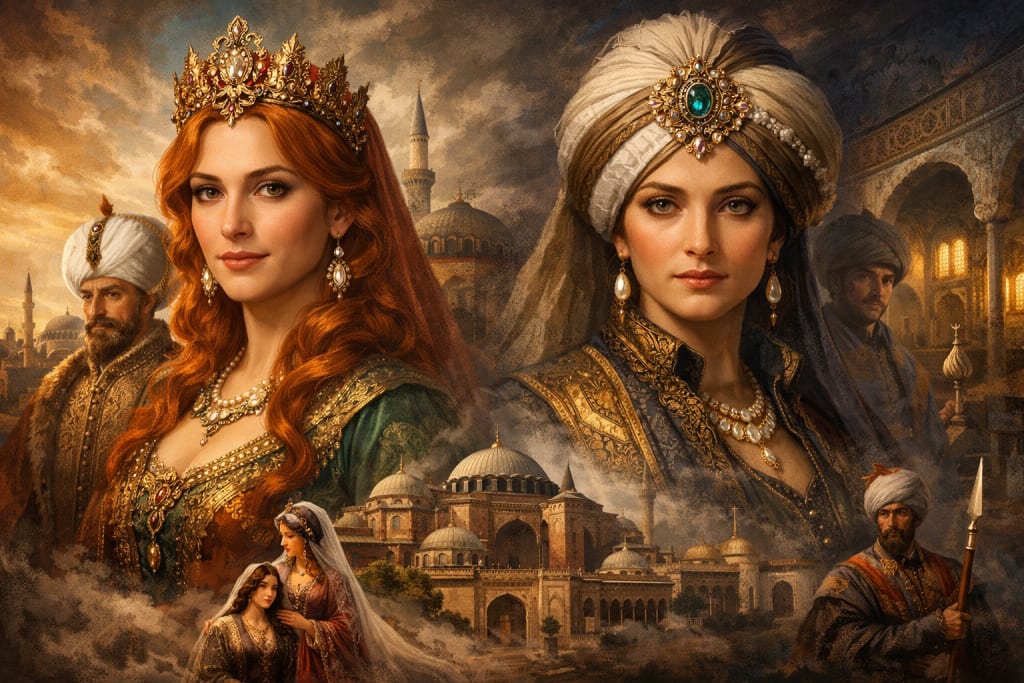
In the history of the Ottoman Empire, the imperial harem is often imagined as a mysterious and secluded world filled with luxury and intrigue. Yet behind the walls of the palace lived women who were far more than companions to the sultans. Some of them rose from slavery to become the most powerful figures in the empire, shaping politics, diplomacy, and the future of the throne itself. Among the most famous of these women were Hürrem Sultan and Kösem Sultan, whose influence defined an era sometimes called the “Sultanate of Women.”
The Ottoman imperial system had a unique approach to royal marriage. Unlike European monarchs who married foreign princesses for political alliances, Ottoman sultans typically took wives from among enslaved women in the palace harem. These women were often brought from different parts of Europe or the Caucasus and trained in palace etiquette, education, and court life. If a concubine caught the attention of the sultan and bore him a son, her status could rise dramatically.
Perhaps the most famous example of this extraordinary rise is Hürrem Sultan, also known in Europe as Roxelana. She entered the palace as a slave but eventually became the beloved wife of Suleiman the Magnificent, one of the greatest rulers of the Ottoman Empire. Breaking centuries of tradition, Suleiman legally married Hürrem, giving her unprecedented influence.
Hürrem Sultan was not merely a romantic figure in the palace. She was deeply involved in state affairs and court politics. Through letters, diplomatic contacts, and political alliances, she played a role in shaping the empire’s decisions. She was also known for her charitable works, commissioning mosques, schools, hospitals, and public kitchens across the empire. Her architectural projects in Istanbul remain important historical landmarks even today.
Hürrem’s influence marked the beginning of an era historians refer to as the “Sultanate of Women,” when royal mothers and wives held immense political power. This period lasted roughly from the mid-16th century to the mid-17th century.
One of the most powerful figures of this era was Kösem Sultan. Like Hürrem, Kösem began her life as a slave but eventually became the wife of Ahmed I. After Ahmed’s death, Kösem’s influence grew even stronger.
Kösem Sultan became the Valide Sultan, or queen mother, when her son Murad IV ascended the throne. Since Murad was very young, Kösem effectively ruled the empire as regent. For several years, she controlled political appointments, managed state affairs, and maintained the stability of the empire during a turbulent time.
Her political career did not end there. Kösem also played a powerful role during the reign of her grandson Mehmed IV. Few women in world history have held such sustained authority in a major empire.
However, life in the imperial palace was often filled with rivalry and danger. Power struggles between royal women, court officials, and princes could become deadly. In 1651, Kösem Sultan herself was assassinated inside the palace during a fierce political conflict with her daughter-in-law, Turhan Sultan.
Despite these dramatic events, the influence of royal concubines reshaped Ottoman politics and culture. These women were not merely figures of luxury and beauty; they were strategic thinkers, patrons of architecture and charity, and sometimes the real decision-makers behind the throne.
Their legacy can still be seen in the architectural monuments they built and in the stories recorded by historians and travelers who visited the Ottoman court. Palaces such as Topkapi Palace still contain the chambers where these women lived, ruled, and planned their strategies.
Today, historians recognize that the imperial harem was far more complex than popular imagination suggests. It was not only a domestic space but also a center of political power where alliances were formed and imperial decisions were influenced.
From the rise of Hürrem Sultan to the dominance of Kösem Sultan, the story of the Ottoman royal concubines reveals a remarkable truth: in an empire ruled by sultans, some of the most powerful figures were women who began their lives as slaves but ended up shaping the destiny of one of the greatest empires in history.
About the Creator
Irshad Abbasi
Ali ibn Abi Talib (RA) said 📚
“Knowledge is better than wealth, because knowledge protects you, while you have to protect wealth.
Keep reading
More stories from Irshad Abbasi and writers in History and other communities.
The Only Coup in American History: The 1898 Massacre and Overthrow in Wilmington
When we discuss the stability of American democracy, the narrative often suggests an unbroken chain of peaceful transfers of power. However, buried within the archives of North Carolina lies a chilling exception: **The Wilmington Massacre of 1898.** It remains the only successful coup d'état on United States soil—a dark day when a violent mob of white supremacists used fire and blood to overthrow a legally elected government.
By Irshad Abbasi about 13 hours ago in History
Review of 'Man on the Run'
My wife and I saw Man on the Run, a nearly 2-hour documentary on Amazon Prime, about Wings, Paul McCartney's group that flew around the world from shortly after The Beatles broke up in early 1970 to shortly after John Lennon was murdered at the end of 1980, making a Beatles reunion forever impossible.
By Paul Levinson6 days ago in Beat


Comments
There are no comments for this story
Be the first to respond and start the conversation.