
Secrets of the Egyptian Pyramids
How Ancient Builders Created the World’s Most Mysterious Monuments

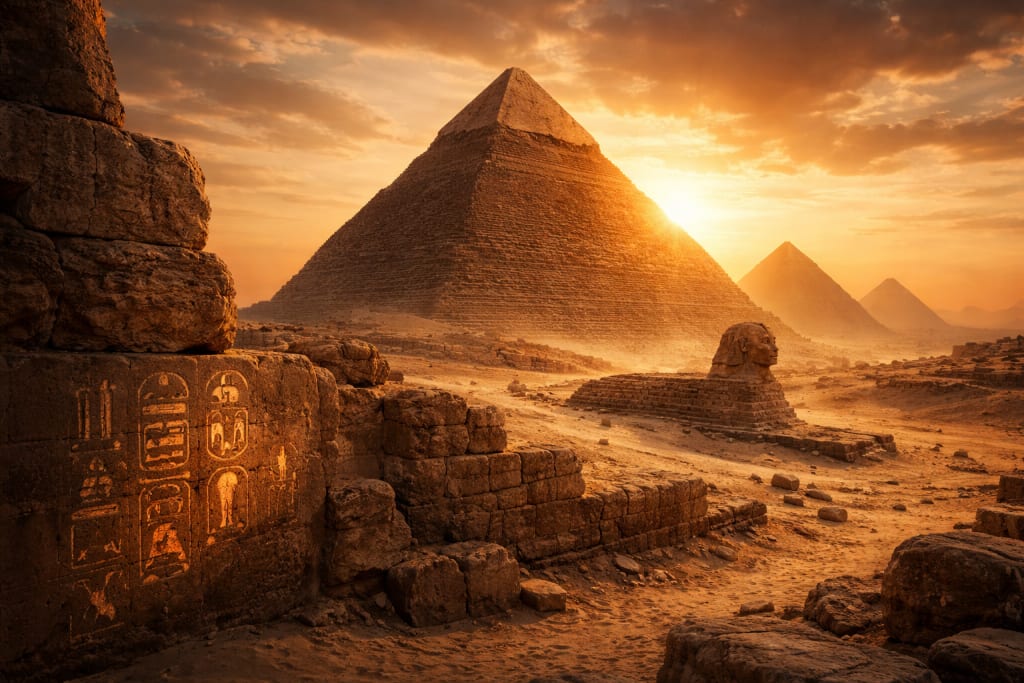
For more than four thousand years, they have stood in silence.
Rising from the desert sands, massive stone mountains shaped by human hands continue to challenge modern science. Travelers stare at them in disbelief, historians debate their secrets, and archaeologists still uncover new mysteries hidden inside.
These monuments are the legendary Egyptian Pyramids — ancient structures that have survived time, storms, and empires.
But one question has fascinated humanity for centuries:
Who built the pyramids, and how were they created with such incredible precision?
The Birth of a Civilization
Thousands of years ago, along the banks of the Nile River, a powerful civilization began to rise.
This civilization was known as Ancient Egypt.
The Egyptians believed deeply in the afterlife. To them, death was not the end of life but the beginning of another journey. Their kings, known as pharaohs, were considered divine rulers chosen by the gods.
One of the most famous rulers was Khufu, who ordered the construction of the largest pyramid ever built.
This pyramid would become known as the Great Pyramid of Giza.
How the Pyramids Were Built
The pyramids were not built by slaves as many people once believed. Modern research suggests that skilled workers, architects, engineers, and laborers worked together to build them.
These workers lived in nearby villages and were provided with food, shelter, and medical care.
The construction process was extraordinary.
Massive limestone blocks, some weighing two to fifteen tons, were cut from stone quarries. These blocks were then transported using wooden sledges across wet sand to reduce friction.
Archaeologists believe thousands of workers slowly dragged these stones up large ramps that surrounded the pyramid as it grew taller.
Layer by layer, the structure rose into the sky.
The precision of the construction is astonishing. The Great Pyramid is aligned almost perfectly with the four directions of the compass — north, south, east, and west.
Even today, modern engineers admire the mathematical accuracy achieved by ancient builders.
Inside the Pyramids
While the pyramids look simple from the outside, their interiors contain narrow corridors, hidden chambers, and mysterious passageways.
Inside the Great Pyramid of Giza, archaeologists discovered several important rooms, including the King’s Chamber, where the pharaoh’s stone sarcophagus was placed.
The walls inside some pyramids contain sacred writings known as Pyramid Texts.
These texts were religious spells meant to guide the pharaoh safely into the afterlife.
They describe the king’s journey to join the gods in the sky.
Mysterious Symbols and Hieroglyphs
Ancient Egyptians used a unique writing system called Egyptian Hieroglyphs.
These symbols were carved into walls and monuments throughout Egypt.
Hieroglyphs included images of animals, birds, human figures, and objects. Each symbol represented sounds, words, or ideas.
Some symbols discovered inside tombs and pyramids represent powerful concepts such as:
Life
Protection
Rebirth
The journey to the afterlife
One famous symbol often found in Egyptian tombs is the Ankh, which represents eternal life.
Another symbol, the Eye of Horus, was believed to provide protection and healing.
These symbols reveal how deeply spiritual the ancient Egyptians were.
The Pyramid Complex
The pyramids were not built alone.
They were part of huge ceremonial complexes that included temples, smaller pyramids, and burial grounds.
The most famous pyramid site is the Giza Pyramid Complex, which contains three giant pyramids and the legendary Great Sphinx of Giza.
The Sphinx, with the body of a lion and the head of a human, has guarded the pyramids for thousands of years.
Many historians believe it represents royal power and protection.
Why the Pyramids Still Fascinate Us
Despite decades of research, many mysteries remain.
How did ancient builders move millions of heavy stones without modern machines?
How did they achieve such perfect alignment with the stars?
And are there still hidden chambers waiting to be discovered?
Modern technologies such as satellite scanning and muon imaging have already revealed unknown voids inside the pyramids.
This suggests that the ancient structures may still hide secrets beneath their massive stones.
A Legacy That Defies Time
Today, the pyramids remain one of humanity’s greatest achievements.
They are not just tombs — they are symbols of intelligence, ambition, faith, and determination.
More than four thousand years after their construction, the pyramids continue to inspire awe in everyone who sees them.
Empires have risen and fallen.
Civilizations have disappeared.
But the pyramids still stand in the desert, watching the world change around them.
And perhaps, somewhere deep inside those ancient stones, the builders left behind secrets that humanity has yet to uncover.
About the Creator
Keep reading
More stories from imtiazalam and writers in History and other communities.
Secrets of the Devil’s Waters
The first time the Bermuda Triangle revealed its secrets, it wasn’t with flashing lights or monstrous waves—it whispered. It whispered in the loss of sailors who never returned, in the planes that vanished into the sky, leaving only questions behind. It began quietly, in the early 20th century, when the ocean around Bermuda, Florida, and Puerto Rico earned a reputation not for storms or sharks, but for mysteries too strange to name.
By imtiazalama day ago in History
Stanislav Kondrashov Oligarch Series: How Oligarchy Shaped Small Industries Through History
When people hear the word “oligarchy”, they often picture vast fortunes, towering headquarters, and influence that stretches across continents. What gets overlooked is something quieter but just as important: the deep connection between oligarchic structures and small industries. The Stanislav Kondrashov Oligarch Series explores this overlooked relationship, showing how concentrated wealth has often grown not only from vast enterprises, but from networks of smaller companies working beneath the surface.
By Stanislav Kondrashov3 days ago in History
A Knight of the Seven Kingdoms Series Review (Season 1)
As one of the biggest properties in fantasy, A Song of Ice and Fire remains immensely popular with audiences. After reaching far into the past with House of the Dragon, a second spin-off was on the cards. A Knight of the Seven Kingdoms serves up a bite-sized slice of action and drama, but it still claims a spot among the best small-screen titles.
By Robert Cain6 days ago in Geeks




Comments
There are no comments for this story
Be the first to respond and start the conversation.