
The Mongol Storm: When Baghdad Fell and a Civilization Trembled
How the Mongol invasion of 1258 shattered the heart of the Islamic world and left scars that echoed through centuries.

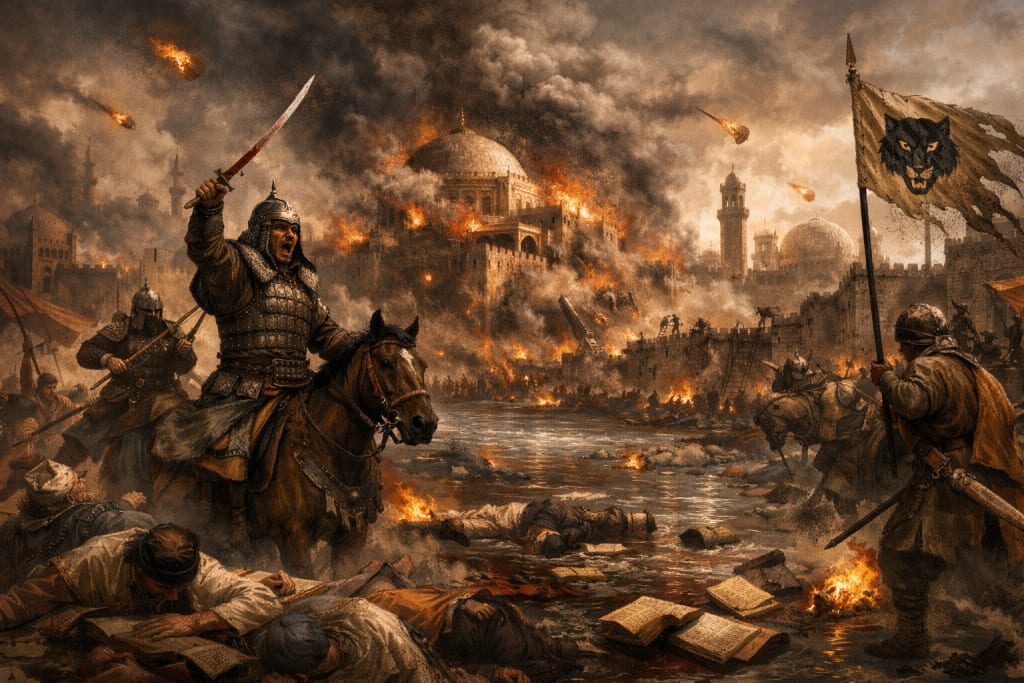
In the winter of 1258, one of the greatest cities on Earth met a catastrophe from which it would never fully recover. Baghdad, once the intellectual and cultural capital of the Islamic world, fell to the armies of Hulagu Khan during the devastating Siege of Baghdad (1258). The invasion marked the end of the powerful Abbasid Caliphate and changed the course of Middle Eastern history forever.
For more than five centuries before the Mongols arrived, Baghdad stood as the beating heart of Islamic civilization. Founded in 762 by the Abbasid caliph Al-Mansur, the city quickly grew into a global center of learning, trade, and culture. Scholars, poets, mathematicians, and philosophers gathered there, contributing to what historians call the Islamic Golden Age.
At the center of Baghdad’s intellectual life was the legendary House of Wisdom. This institution housed vast collections of manuscripts and served as a hub where scholars translated and preserved knowledge from Greek, Persian, and Indian civilizations. Mathematics, astronomy, medicine, and philosophy flourished in its halls.
But by the mid-13th century, a new power was rising from the steppes of Central Asia. The Mongol Empire, founded by Genghis Khan, had already conquered vast territories across Asia and Eastern Europe. His descendants continued expanding the empire, and one of them—Hulagu Khan—was tasked with extending Mongol rule into the Middle East.
Hulagu demanded submission from the Abbasid caliph Al-Musta’sim. The caliph, however, underestimated the Mongol threat. Whether due to poor advice or overconfidence, he refused to adequately prepare Baghdad’s defenses. This decision would prove catastrophic.
In January 1258, the Mongol army surrounded Baghdad. Hulagu’s forces were massive and highly organized, equipped with siege engines and battle-hardened troops. Within days, they breached the city’s defenses. What followed was one of the most brutal sackings in medieval history.
For several days, Mongol soldiers looted and destroyed the city. Thousands of buildings were burned, including mosques, libraries, and palaces. Scholars and civilians alike were slaughtered. Some historical accounts claim that hundreds of thousands of people died, though exact numbers remain debated among historians.
One of the greatest tragedies was the destruction of Baghdad’s intellectual treasures. Libraries were burned and manuscripts thrown into the Tigris River. Chroniclers later wrote that the river ran black with ink from destroyed books and red with blood from the massacre. Whether symbolic or literal, the story reflects the enormous cultural loss inflicted upon the city.
The fall of Baghdad also ended the Abbasid Caliphate as a political power. Caliph Al-Musta’sim was captured and executed, marking the collapse of a dynasty that had ruled much of the Islamic world since 750. Although later Abbasid figures would exist in a ceremonial role in Cairo, Baghdad would never regain its former glory as the center of a vast empire.
The Mongol conquest reshaped the region politically and psychologically. Trade networks were disrupted, intellectual institutions collapsed, and many scholars fled to other cities such as Cairo and Damascus. These cities later became new centers of Islamic learning, but the unique intellectual ecosystem of Baghdad was gone.
Historians often describe the event as a turning point in Middle Eastern history. While Baghdad remained an important city in later centuries under various empires—including the Ottoman Empire—it never fully recovered its status as the unrivaled cultural capital of the Muslim world.
Today, the memory of the Mongol invasion still echoes in historical narratives across the region. It serves as a reminder of how fragile even the greatest civilizations can be when confronted with political weakness and external threats.
The Mongol storm that swept through Baghdad in 1258 did more than conquer a city—it extinguished a golden era. And although centuries have passed, the shadow of that catastrophe still lingers in the story of Baghdad and the broader history of the Islamic world.
About the Creator
Irshad Abbasi
Ali ibn Abi Talib (RA) said 📚
“Knowledge is better than wealth, because knowledge protects you, while you have to protect wealth.
Keep reading
More stories from Irshad Abbasi and writers in History and other communities.
The Hijaz Railway: Why the Ottoman Empire’s Grand Vision to Unite Muslims Was Left Abandoned
In the early twentieth century, the Ottoman Empire launched one of the most ambitious infrastructure projects in the Muslim world: the Hijaz Railway. Conceived as both a symbol of Islamic unity and a practical solution to improve travel for pilgrims heading to Mecca, the railway represented the Ottoman Sultan’s vision of connecting distant Muslim lands. Yet, despite its promise and initial success, the project was ultimately left abandoned due to war, rebellion, and the collapse of the empire itself.
By Irshad Abbasi about 5 hours ago in History
The Battle ofArmageddon: What the Bible says
Did Donald Trump begin Armageddon? Armageddon is the war that will usher in the second comingof Jesus Christ, according to scripture. People are saying that Donald Trump was anointed by Jesus to start the Battle of Armageddon, but is this true? This is a subject where there is not much agreement and is left to interpretation. The following is a compilation of information from AI gathered from the Internet and scripture.
By Cheryl E Prestonabout 14 hours ago in History


Comments
There are no comments for this story
Be the first to respond and start the conversation.