
When Bullets Silenced a Peaceful Crowd
How General Dyer’s chilling order to “reload and fire where the crowd is thickest” turned a peaceful gathering in Amritsar into one of the darkest tragedies of colonial rule.

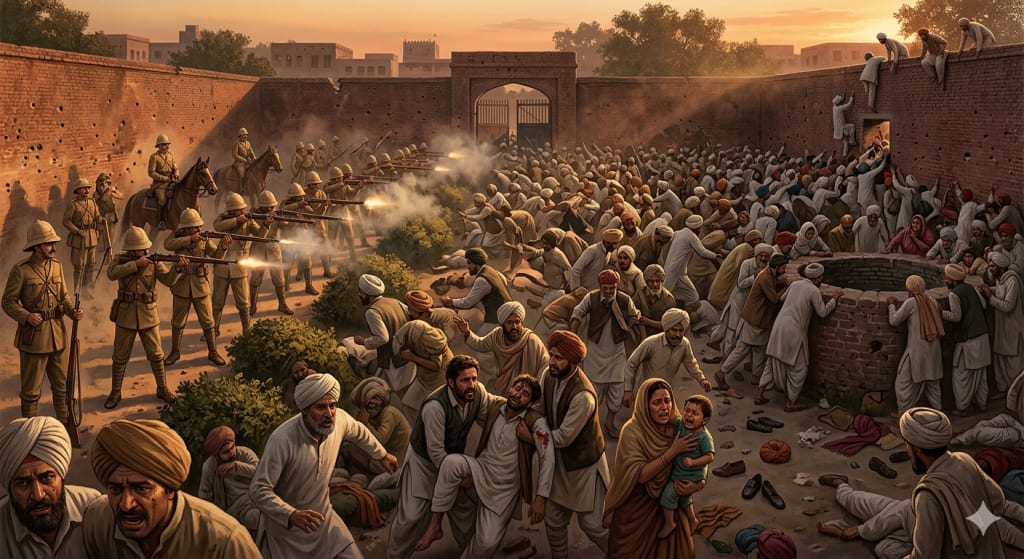
On April 13, 1919, a quiet garden in the city of Amritsar became the site of one of the most horrifying incidents in the history of British colonial rule in India. The event, now known as the Jallianwala Bagh Massacre, shocked the world and exposed the brutal reality of imperial power.
The day coincided with the Punjabi festival of Baisakhi, a time when thousands of people from surrounding villages came to Amritsar to celebrate and socialize. Many of them gathered in the enclosed garden of Jallianwala Bagh, unaware that the city was already tense following the arrest of two prominent Indian leaders who had been protesting against British policies.
Just days earlier, the colonial government had passed the controversial Rowlatt Act, which allowed authorities to arrest people without trial and suppress political activities. The act angered Indians across the country, leading to protests and demonstrations. In Amritsar, public meetings were banned, but many villagers who had come for the festival did not know about the restrictions.
That afternoon, thousands of men, women, and children gathered in the garden. Some came to protest peacefully against British policies, while others simply came to relax after the festival celebrations. The garden was surrounded by walls with only a few narrow exits, making it difficult for large crowds to leave quickly.
Suddenly, troops led by British officer Reginald Dyer entered the garden. Without warning the crowd to disperse, Dyer positioned his soldiers near the main entrance and ordered them to open fire.
What followed was ten minutes of relentless gunfire that would change the course of Indian history.
According to eyewitness accounts, Dyer gave a shocking command to his troops: reload your rifles and aim where the crowd was densest. His intention was not merely to disperse the gathering but to “teach a moral lesson,” as he later admitted.
The soldiers fired approximately 1,650 rounds into the trapped crowd. Panic spread instantly. People ran toward the narrow exits, but many were blocked or crushed in the stampede. Others jumped into a well inside the garden in desperate attempts to escape the bullets.
By the time the firing stopped, the ground was covered with bodies and wounded victims crying for help.
The official British report later claimed that 379 people were killed and more than 1,000 injured. However, Indian leaders and independent investigations estimated that the death toll was far higher, possibly exceeding 1,000.
The brutality of the massacre shocked not only India but also the international community. Even within Britain, many politicians and intellectuals condemned the action.
One of the most powerful responses came from the renowned poet Rabindranath Tagore, who had been awarded a knighthood by the British Crown. In protest against the massacre, Tagore renounced his title, declaring that such honors meant nothing in the face of such cruelty.
The tragedy also deeply affected Indian political leaders. Mahatma Gandhi, who had previously hoped for cooperation between Indians and the British government, was profoundly shaken. The massacre strengthened his resolve to lead a nationwide movement of non-cooperation against colonial rule.
For many Indians, Jallianwala Bagh became a symbol of oppression and injustice. It demonstrated that peaceful protest could still be met with ruthless violence under colonial authority.
Although Dyer was later investigated by a British commission, he never faced criminal punishment. He was removed from his command but was supported by some British groups who viewed him as a defender of imperial order.
Over time, however, history judged the event very differently. The massacre is now widely regarded as one of the most shameful episodes of British colonial rule in India.
Today, the site of Jallianwala Bagh in Amritsar has been transformed into a national memorial. The bullet marks on the walls and the well into which terrified people jumped still remain as silent witnesses to that tragic day.
More than a century later, the massacre continues to remind the world of the devastating consequences of unchecked power and the courage of those who struggled for freedom. The bloodshed at Jallianwala Bagh did not silence India’s demand for independence; instead, it strengthened the resolve of millions to fight for justice and self-determination.
The echoes of that day still linger in history, reminding us that the pursuit of freedom often comes at a painful cost.
About the Creator
Irshad Abbasi
Ali ibn Abi Talib (RA) said 📚
“Knowledge is better than wealth, because knowledge protects you, while you have to protect wealth.
Keep reading
More stories from Irshad Abbasi and writers in History and other communities.
When Bullets Turned a Garden into a Graveyard
On April 13, 1919, a peaceful gathering in the northern Indian city of Amritsar turned into one of the most tragic and defining events in the history of British colonial rule in South Asia. The incident, now known as the Jallianwala Bagh Massacre, left hundreds of unarmed civilians dead and thousands wounded. More than a century later, the bullet marks that remain on the walls of the garden serve as a silent reminder of the brutality that unfolded that day.
By Irshad Abbasi about 10 hours ago in History


Comments
There are no comments for this story
Be the first to respond and start the conversation.