
When the British Challenged Aurangzeb Alamgir
A historical reflection on the early encounters between the Mughal Empire and European trading powers

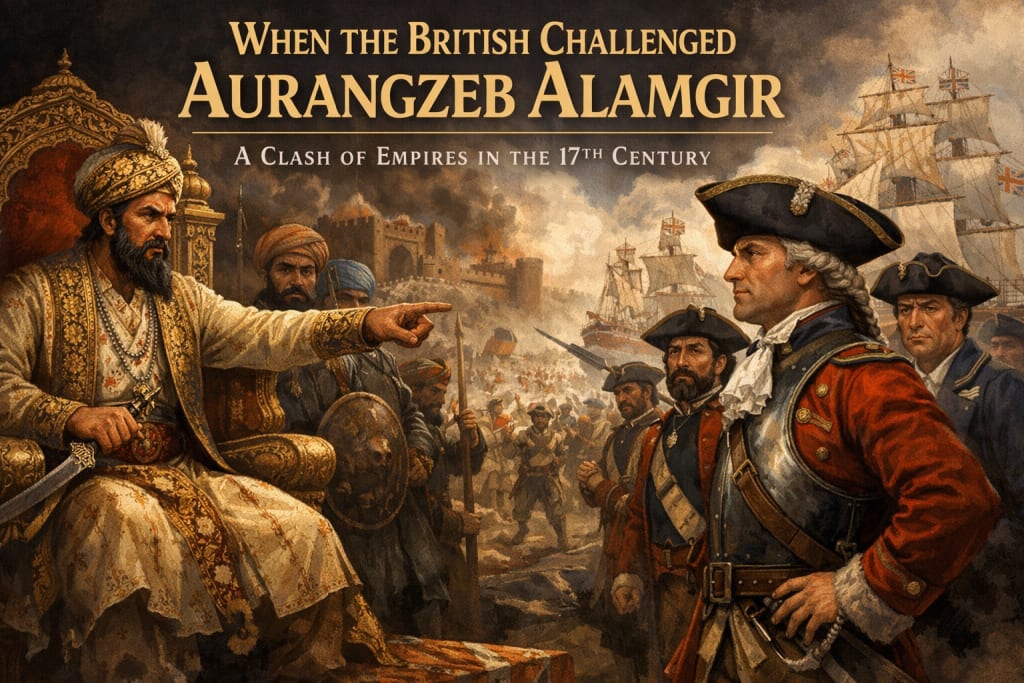
The reign of Aurangzeb Alamgir (1658–1707) marked the last great expansion of the Mughal Empire, but it was also a period when new foreign powers were quietly testing the strength of the empire. Among these rising forces was the British East India Company, a commercial organization that had arrived in India with the intention of trade but gradually began to challenge the authority of the Mughal state.
By the time Aurangzeb came to power, European traders had already established a presence along India’s coasts. The Portuguese had arrived earlier, followed by the Dutch and the English. The British East India Company, founded in 1600, had obtained permission from earlier Mughal rulers to set up trading factories in cities like Surat and Madras. Initially, the company presented itself as a humble trading partner, exporting spices, textiles, and other goods to Europe.
However, as trade grew more profitable, the company began seeking greater autonomy and privileges. Tensions slowly developed between Mughal officials and English merchants over customs duties, trade rights, and local authority. During Aurangzeb’s rule, these tensions eventually erupted into open conflict in what historians call the Child’s War.
The war was named after Sir Josiah Child, a powerful director of the East India Company who believed that the company could pressure the Mughal Empire into granting greater privileges. The company assumed that the Mughal authorities would not strongly resist European traders. This assumption proved to be a serious miscalculation.
In 1686, the East India Company initiated aggressive actions against Mughal territories. English forces attacked Mughal ports and disrupted trade routes, hoping to force concessions. They also attempted to strengthen their military presence in Bengal and along the western coast. From the British perspective, these moves were meant to secure favorable trading conditions.
Aurangzeb, however, responded with decisive authority. As one of the most powerful rulers of the time, he commanded a vast empire stretching across most of the Indian subcontinent. The Mughal military was far stronger than the scattered forces of the East India Company. When news of the English attacks reached the emperor, he ordered Mughal governors and naval forces to retaliate.
The Mughal response was swift and overwhelming. Mughal troops captured several English trading posts and imprisoned company officials. In Bengal, the English were driven out of their settlements, while Mughal fleets targeted company ships. The once-confident English merchants suddenly realized they were facing the full might of the Mughal state.
The conflict quickly turned disastrous for the East India Company. Their military resources were limited, and they could not sustain a prolonged war against such a powerful empire. Mughal forces blockaded English settlements, seized their goods, and threatened to expel them entirely from India.
Realizing the gravity of their mistake, the company leaders sought peace. In 1690, they formally apologized to Aurangzeb and requested forgiveness. According to historical records, the East India Company agreed to pay heavy fines and promised to respect Mughal authority. Aurangzeb allowed them to resume trade but under strict conditions.
This episode demonstrated the immense power of the Mughal Empire during Aurangzeb’s reign. At that time, the British were far from the dominant colonial force they would later become. Instead, they were merely traders dependent on the goodwill of local rulers.
Ironically, the situation would change dramatically in the following decades. After Aurangzeb’s death in 1707, the Mughal Empire gradually weakened due to internal conflicts, regional rebellions, and administrative challenges. As central authority declined, the East India Company slowly expanded its influence, using diplomacy, alliances, and eventually military force.
Events like the Battle of Plassey later transformed the company from a trading organization into a political power. What began as a small commercial presence eventually led to British colonial rule over large parts of the Indian subcontinent.
The confrontation between Aurangzeb and the East India Company remains a fascinating chapter in history. It reminds us that during the late 17th century, the Mughal Empire was still strong enough to challenge and defeat European traders. The British challenge during Aurangzeb’s reign did not end in conquest but in humiliation and submission.
Yet history is full of turning points. What seemed like a minor dispute between traders and an emperor eventually became the first step in a long and complex story that reshaped the future of South Asia.
About the Creator
Irshad Abbasi
Ali ibn Abi Talib (RA) said 📚
“Knowledge is better than wealth, because knowledge protects you, while you have to protect wealth.
Keep reading
More stories from Irshad Abbasi and writers in History and other communities.
The Queen of Jhansi : The British Must Never Capture My Body”
In the long history of resistance against colonial rule in the Indian subcontinent, few figures shine as brightly as Rani Lakshmibai, the legendary Queen of Jhansi. Remembered for her courage, leadership, and unwavering determination, she became one of the most powerful symbols of defiance during the Indian Rebellion of 1857. Her story is not only about war but also about dignity, honor, and a final wish that echoed through history: the British must never capture her body.
By Irshad Abbasi about 8 hours ago in History
The Year 2004 in Review: Fun Facts, Trivia, and Historic Highlights
This quick read is a collection of fun facts, trivia, and historical events from the year 2004. Discover the year’s top news stories, most influential people, sports facts, computer history, entertainment trivia, and much more.
By Gregory DeVictor4 days ago in History
Why Didn't Anyone Tell Us
Men, move along. This is not for you. This is for the women. I was forty-five when I began menopause. It is pretty young for that to be going on in a woman’s life, but I had undiagnosed PCOS, my entire life. Thank you to all the gynecologists I had seen my entire life. That in itself should encourage women to keep seeking second opinions, especially when you are not getting correct answers or any at all.
By Alexandra Grant2 days ago in Humans




Comments
There are no comments for this story
Be the first to respond and start the conversation.