
WHY ARAB STATES BEING TARGETED?
Are Arab States Really The Victims?


It is absolutely clear that they will go after every country that threatens Israel or is considered an existential or security threat to it. The agenda of Washington, D.C. is very clear: they will target every country that threatens Israel, and either destroy it through carpet bombing or erase it, just as they did with Atomic bombings of Hiroshima and Nagasaki.
The way bombing is taking place against Iran, without even considering where civilian infrastructure exists, shows a disregard for the principles of war. After all, even wars have rules. Ignoring all of these norms, the way such actions are carried out suggests that only one objective is intended: to turn every country that does not surrender to your will into a client state.
Look at Iraq, Libya, and Yemen. Look at Syria as well, where in the name of Bashar al‑Assad, chaos was ultimately created. Even after witnessing all this, the Gulf states believed in a theory. That theory was that if your investments are protected, if you are investing there, if you are part of the Western financial system, and if you are aligned diplomatically with it, then your security is guaranteed.
But what this war is revealing is something entirely different: Washington may ultimately throw you under the bus. Your land may be used as part of the system, and even when you suffer the consequences, you may not be able to do anything about it.
This should have become clear during the previous tensions between Iran and Israel—that this strategy is no longer working. Yet, if you still remain within the American orbit, that again becomes a strategic choice.
Saudi Arabia has deeply integrated its entire petrodollar system into the Western financial system.
United Arab Emirates has presented itself as a hub for Western capital.
Qatar hosts some of the largest American military bases and at times funds regional actors when necessary.
This means that the alignment is not only economic but also political. The United Arab Emirates is part of the Abraham Accords and has already established diplomatic relations with Israel. Saudi Arabia does not openly acknowledge it because it plays a leadership role in the Muslim world and holds the custodianship of the holy cities, but everyone knows that its ties are active, deliberate, and strategic.
Saudi Arabia has chosen to remain part of the petrodollar system. So when missiles are being fired, infrastructure is being destroyed, and airspace is being violated, these developments are, in many ways, the result of those strategic choices.
Missile exchanges between Iran and Israel are increasing, and the direct casualties are rising day by day. The airspace of the United Arab Emirates is being violated, infrastructure is being targeted, airports are being shut down, and oil routes are under pressure.
Yet the global media often presents this as if certain states are victims who have been dragged into a war by others. That is not really the case. You are never purely a victim when you have made certain strategic choices.
Iran made a strategic choice: it decided to maintain asymmetry, it launched proxies, and it took a clear stance to fight back against Israel. In response, others also adopted their own strategies. In a way, you became the architect of the exposure that you are facing today.
If we want to understand this in depth, the key question is: when Iran decided to fight back, whose support did you rely on? The answer is Washington, D.C..
Therefore, the narrative that Arab states had no choice should be challenged. It is often claimed that Iran is simply attacking them and committing aggression. But the right of self-defense becomes highly debatable when American military bases exist on your territory.
Another narrative—or myth—that has now been shattered is the belief that if you have powerful friends, if Washington is your ally, then your security is guaranteed.
What is happening now shows something different: you are paying the price for policies that may not have fully incorporated realism about the region when those decisions were made, especially when choosing to align closely with the West.
About the Creator
Ibrahim Shah
I am an Assistant Professor with a strong commitment to teaching,and academic service. My work focuses on fostering critical thinking, encouraging interdisciplinary learning, and supporting student development.
Keep reading
More stories from Ibrahim Shah and writers in The Swamp and other communities.
US Foreign Policy About Iran
Regime change, change control—these are all the issues involved. What do you actually want? Politically, what is your real endgame? The United States has never really cared about what will happen to the people of Afghanistan. You saw it just four or five years ago—how much concern did the U.S. show about the people it was leaving behind and what the Taliban might do to them?
By Ibrahim Shah 2 days ago in The Swamp
Parallel Protests
I haven't written for quite some time, but I have A LOT of thoughts about yesterday's protest rally against our government's involvement and complicity in America's war on Iran, on the harbourside of my home city Bristol, and I need to put them somewhere. My gorgeous girlfriend is always a loving and listening ear and sharing it all with her will always be a healthy and happy way of processing the mental and emotional weight, but getting it straight in my brain to share means writing it all down in straight lines, so, here we are and thanks for being here.
By Steph Cole10 days ago in The Swamp
US and Mideast Countries Seek Kyiv’s Drone Expertise as Russia-Ukraine Talks Put on Ice
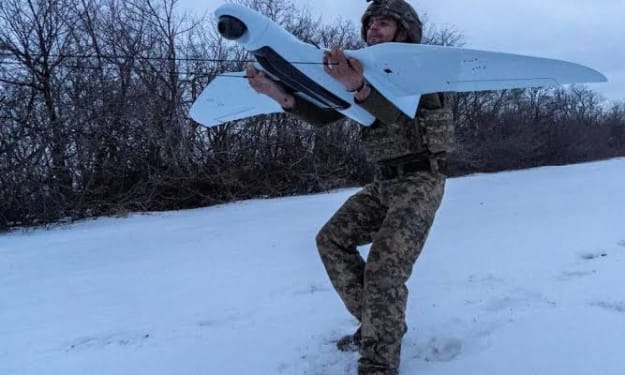
The ongoing war in Ukraine has unexpectedly transformed Kyiv into one of the world’s most influential centers of drone warfare expertise. Now, as tensions escalate in the Middle East and diplomatic talks between Russia and Ukraine stall, the United States and several Middle Eastern countries are turning to Ukraine for help in defending against drone attacks. According to Ukrainian President Volodymyr Zelenskyy, governments in both Washington and the Gulf region have approached Kyiv seeking guidance on how to counter Iranian-made attack drones. Over the past four years of war with Russia, Ukraine has gained extensive battlefield experience defending its cities, infrastructure, and military positions from waves of unmanned aerial vehicles used by Russian forces. These drones — many of them based on the Iranian-designed Shahed drone — have become a defining feature of the conflict. Russia has launched tens of thousands of them against Ukrainian targets since the invasion began in 2022, forcing Ukraine to rapidly innovate new defensive techniques and technologies. In recent weeks, Zelenskyy said he held discussions with leaders from several Middle Eastern countries, including the United Arab Emirates, Qatar, Bahrain, Jordan, and Kuwait. These governments are increasingly concerned about the threat posed by Iranian drone technology in the region and are eager to learn from Ukraine’s combat-tested experience. The interest comes as tensions in the Middle East have intensified following a new round of hostilities involving Iran. Iranian drones have been deployed in attacks across the region, raising alarms about the vulnerability of critical infrastructure such as oil facilities, airports, and power plants. Ukraine’s response to similar threats has relied on a combination of innovation and necessity. Because traditional air-defense systems are expensive and limited in supply, Ukrainian engineers and military planners developed alternative strategies. These include electronic warfare systems that jam drone signals, mobile anti-aircraft units, and even specialized interceptor drones designed to hunt down and destroy incoming UAVs. One particularly notable innovation has been the development of extremely low-cost counter-drone systems. Some Ukrainian interceptor drones cost as little as $1,000, making them far cheaper than conventional missile-based defenses that can cost hundreds of thousands of dollars per shot. This affordability has drawn the attention of military planners around the world. In modern conflicts where drones are used in large numbers, traditional missile systems can quickly become economically unsustainable. Ukraine’s approach — combining inexpensive technologies with layered defense strategies — has shown how countries can defend themselves against mass drone attacks without exhausting their defense budgets. The new cooperation discussions also reflect a broader geopolitical shift. Ukraine’s experience in drone warfare has effectively turned the country into a laboratory for modern combat technologies. Lessons learned on Ukrainian battlefields are now influencing defense strategies far beyond Europe. At the same time, Kyiv is carefully weighing how much assistance it can provide. Zelenskyy emphasized that any sharing of expertise or equipment must not weaken Ukraine’s own defensive capabilities. The country remains locked in a prolonged war with Russia, and protecting its airspace remains the top priority. “We help defend those who help Ukraine bring a just end to the war,” Zelenskyy said in remarks outlining Kyiv’s approach to international cooperation. Meanwhile, diplomatic efforts to end the war between Russia and Ukraine have been put on hold. A new round of U.S.-brokered talks had been expected to take place this week, but the escalating crisis in the Middle East has diverted international attention and delayed negotiations. The pause in diplomacy underscores how interconnected global conflicts have become. Developments in one region can quickly reshape the strategic landscape elsewhere, drawing new actors into existing conflicts. For Ukraine, the sudden demand for its expertise represents both an opportunity and a challenge. On one hand, sharing its knowledge could strengthen alliances and expand its global influence. On the other, Kyiv must balance those partnerships with the urgent demands of its own war effort. As drone warfare becomes an increasingly dominant feature of modern battlefields, Ukraine’s experience may prove to be one of the most valuable strategic assets to emerge from the conflict.
By Fiaz Ahmed 7 days ago in The Swamp
Why Didn't Anyone Tell Us
Men, move along. This is not for you. This is for the women. I was forty-five when I began menopause. It is pretty young for that to be going on in a woman’s life, but I had undiagnosed PCOS, my entire life. Thank you to all the gynecologists I had seen my entire life. That in itself should encourage women to keep seeking second opinions, especially when you are not getting correct answers or any at all.
By Alexandra Grant3 days ago in Humans



Comments
There are no comments for this story
Be the first to respond and start the conversation.