
How a feared Mediterranean corsair rose to become Grand Admiral of the Ottoman Empire and reshaped naval power in the 16th century
Khayr al-Din Barbarossa: The Pirate Who Became the “King of the Seas”

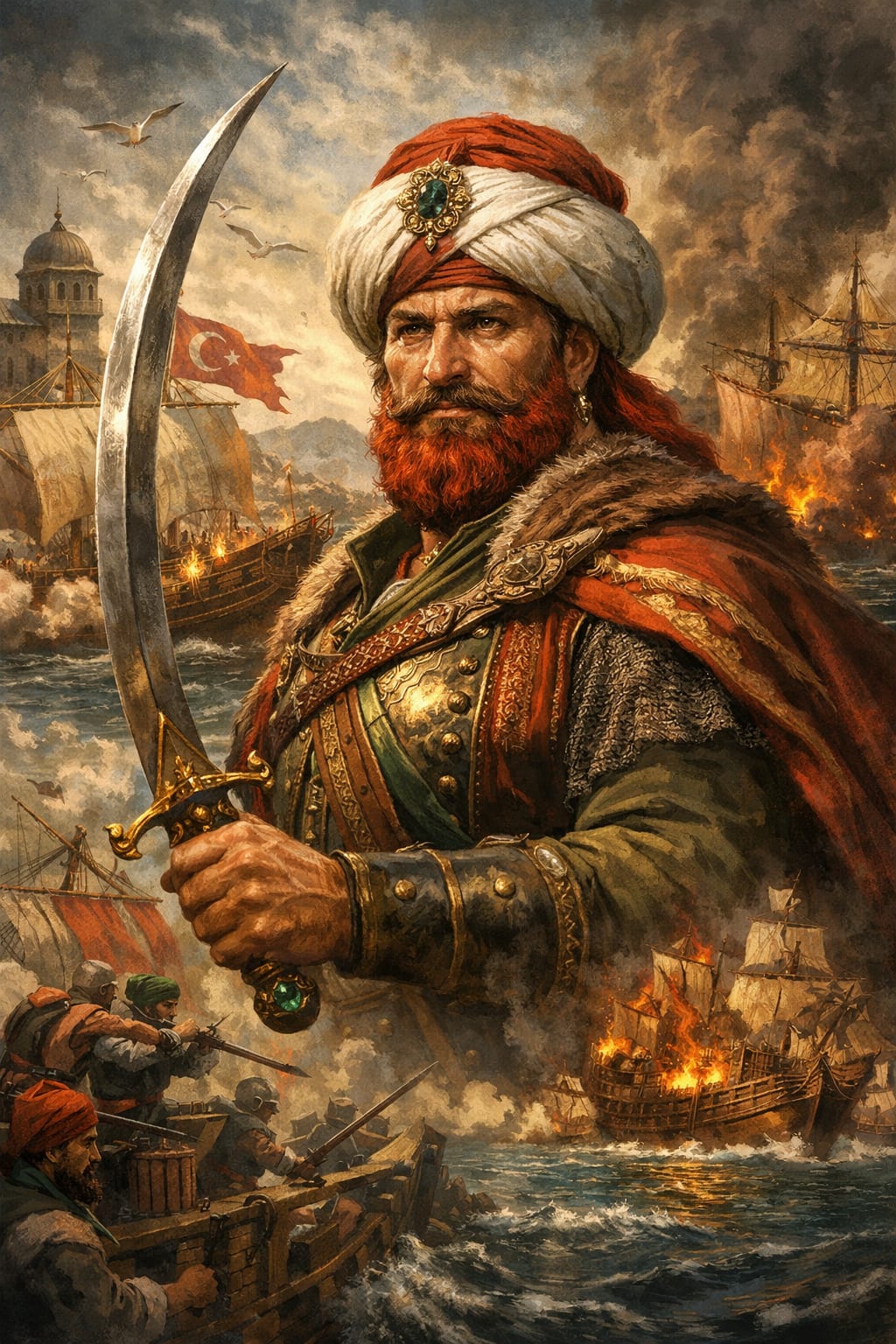
In the turbulent waters of the 16th-century Mediterranean, where empires clashed and trade routes determined the fate of nations, one name inspired both fear and admiration: **Khayr al-Din Barbarossa**. Known in Europe as “Barbarossa,” meaning “Red Beard,” he began his life as a corsair—what many would call a pirate—but rose to become the Grand Admiral of the mighty **Ottoman Empire**. His journey from privateer to imperial commander is a remarkable tale of ambition, strategy, and shifting loyalties.
### From the Aegean to the High Seas
Khayr al-Din was born around 1478 on the island of Lesbos, shortly after it had come under Ottoman control. His birth name was Hızır Reis. He was one of four brothers, all of whom would become sailors. The most famous among them, before Hızır himself, was his elder brother **Oruç Reis**.
The brothers began as traders but soon turned to privateering in the Mediterranean. At the time, the sea was a battlefield between Christian European powers—particularly Spain—and Muslim states of North Africa and the Ottoman realm. Muslim corsairs were often seen as defenders of Islamic lands, attacking Spanish and Italian ships and coastal towns. In Europe, they were labeled pirates; in the Muslim world, many saw them as warriors of faith.
After Oruç lost an arm in battle, Europeans nicknamed him “Barbarossa” because of his red beard. Over time, this nickname passed on to Hızır as well.
### Building a Power Base in North Africa
The early 16th century was marked by Spanish expansion along the North African coast. Spain captured key ports such as Oran and sought to dominate the western Mediterranean. The Barbarossa brothers positioned themselves as protectors of Muslim territories against Spanish aggression.
In 1516, Oruç and Hızır seized control of Algiers, overthrowing its ruler. Oruç declared himself Sultan of Algiers, but his reign was short-lived. In 1518, he was killed while fighting Spanish forces. After his brother’s death, Hızır took command.
Recognizing the need for greater support, Hızır pledged allegiance to the Ottoman Sultan **Selim I**. In return, the Ottoman ruler granted him military assistance and formally appointed him Beylerbey (Governor) of Algiers. It was at this moment that Hızır received the honorific title “Khayr al-Din,” meaning “Goodness of the Faith.”
This alliance transformed him from a regional corsair leader into an official representative of the Ottoman state. Algiers became an Ottoman province, and Barbarossa gained access to imperial resources.
### Rise to Grand Admiral
Under Sultan **Suleiman the Magnificent**, the Ottoman Empire reached the height of its power. Suleiman recognized Barbarossa’s naval genius and summoned him to Istanbul. In 1533, Khayr al-Din Barbarossa was appointed Kapudan Pasha, or Grand Admiral of the Ottoman fleet.
This marked a dramatic transformation: a man once considered a pirate by European powers was now commander of one of the world’s most formidable navies.
Barbarossa reorganized and expanded the Ottoman fleet, turning it into a disciplined and strategic force. He understood not only naval combat but also logistics, coastal fortifications, and political alliances.
### The Battle That Changed the Mediterranean
Barbarossa’s greatest triumph came in 1538 at the Battle of Preveza. A Holy League fleet organized by the Pope and led by the Genoese admiral Andrea Doria sought to curb Ottoman expansion. The clash occurred near the coast of western Greece.
Despite being outnumbered, Barbarossa used superior tactics and knowledge of local waters to defeat the Christian fleet decisively. The Ottoman victory at Preveza secured Ottoman dominance in the eastern Mediterranean for decades.
After Preveza, the Mediterranean was effectively divided: the Ottomans controlled the east and much of North Africa, while Spain and its allies held the western regions. Barbarossa’s success reshaped the balance of power.
### Pirate or Admiral?
Was Barbarossa truly a pirate? The answer depends on perspective. To Spain and other European states, he was a ruthless corsair who raided ships and coastal towns. To the Ottomans, he was a loyal commander defending imperial interests. In the 16th century, the line between pirate and privateer was often blurred. Many naval commanders operated with state approval to attack enemy shipping.
Barbarossa also played a diplomatic role. He cooperated with France—an unlikely Muslim-Christian alliance—against their mutual rival, the Habsburg Empire. This pragmatic politics demonstrated that power, not religion alone, shaped Mediterranean alliances.
### Legacy of the “King of the Seas”
Khayr al-Din Barbarossa died in 1546 in Istanbul. He was buried overlooking the Bosporus, and his mausoleum still stands today. Ottoman sailors would reportedly salute his tomb before departing on naval missions.
His legacy is complex. He was both feared and respected, a symbol of Ottoman naval supremacy. Under his command, the Ottoman Empire became the dominant maritime power of its age.
Barbarossa’s life illustrates how skill, ambition, and political intelligence can transform a man’s destiny. From a corsair roaming dangerous waters to the Grand Admiral of an empire, he earned the title many gave him: the “King of the Seas.”
About the Creator
Irshad Abbasi
Ali ibn Abi Talib (RA) said 📚
“Knowledge is better than wealth, because knowledge protects you, while you have to protect wealth.
Keep reading
More stories from Irshad Abbasi and writers in History and other communities.
The Partition of the Ottoman Empire: How Britain and France Reshaped the Middle East
The collapse of the Ottoman Empire after World War I dramatically transformed the political map of the Middle East. For more than four centuries, the Ottoman Empire had ruled vast territories stretching across the Middle East, North Africa, and parts of Europe. However, by the early twentieth century, the empire had weakened politically, economically, and militarily. When the Ottomans joined Germany and the Central Powers in World War I, Britain and France saw an opportunity to reshape the region according to their own strategic and economic interests. The result was the partition of Ottoman lands, an event that still shapes Middle Eastern politics today.
By Irshad Abbasi about 12 hours ago in History
The Exorcist instills fear, but Christ gave authority over evil
Another version of The Exorcist is coming Different cultures have their own methods of dealing with the supernatural. This article is based on my experience and is not intended to guarantee anyone the results they will have should they encounter evil spirits.
By Cheryl E Preston12 minutes ago in History


Comments
There are no comments for this story
Be the first to respond and start the conversation.