
After the Führer: Who Inherited Adolf Hitler’s Vast Wealth?
Tracing the fate of Adolf Hitler’s fortune after the fall of the Third Reich and the legal battles that followed his death

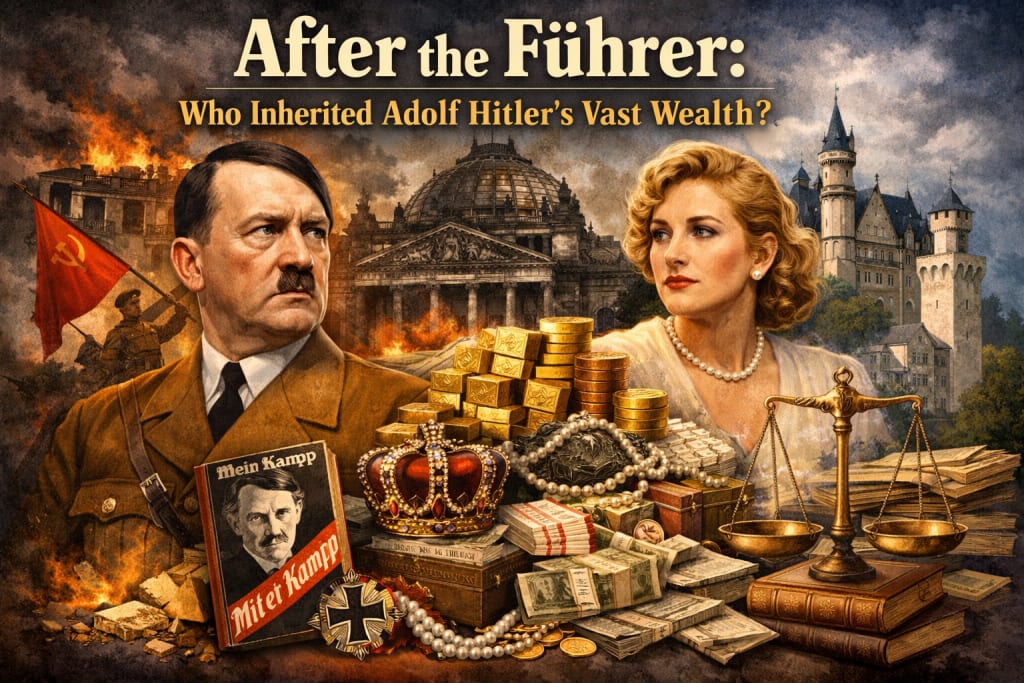
When Adolf Hitler died by suicide on April 30, 1945, inside his bunker in Berlin, the Third Reich was collapsing around him. Soviet troops were closing in, and Nazi Germany was on the brink of total defeat. Yet even as Europe lay in ruins, a curious legal and financial question lingered: what happened to Hitler’s personal wealth, estimated to be worth hundreds of millions—if not billions—of today’s dollars?
### The Myth and Reality of Hitler’s Fortune
Hitler was not merely a political leader; he was also one of the wealthiest men in Germany during the height of Nazi power. His income came from several sources. Chief among them were the enormous royalties from his autobiographical manifesto, *Mein Kampf*. After becoming Chancellor in 1933, every newly married couple in Germany was often gifted a copy of the book by the state, dramatically increasing sales.
Beyond book royalties, Hitler earned income from image rights, state stipends, and “donations” from industrialists eager to curry favor with the regime. He paid virtually no taxes after coming to power, and much of his lifestyle—residences, vehicles, staff—was funded by the state. His mountain retreat, the Berghof in Bavaria, became an iconic symbol of Nazi authority.
Despite these vast resources, much of Hitler’s wealth was entangled with the Nazi state itself. As Germany crumbled in 1945, it became difficult to separate personal property from looted art, seized assets, and state-controlled funds.
### Hitler’s Last Will and Testament
On April 29, 1945, one day before his suicide, Hitler dictated his political and personal testaments in the Führerbunker. In his personal will, he named several beneficiaries. He left personal possessions of sentimental value to close associates. Most significantly, he stated that his belongings should go to the Nazi Party—if it still existed. If the party no longer functioned, his estate was to pass to the German state. If even that proved impossible, he wrote, no further decision was necessary.
He also made specific bequests to individuals such as his private secretary and members of his household staff. Notably, he made no grand financial provision for distant relatives.
His wife of one day, Eva Braun, whom he married shortly before their joint suicide, also left a will. However, like Hitler’s, it became largely symbolic given the chaos of Germany’s surrender.
### Allied Seizure and Legal Proceedings
After Germany’s unconditional surrender on May 7, 1945, the Allied powers began dismantling the Nazi regime’s structures. Under denazification policies, Nazi assets were confiscated. The Bavarian authorities, operating under American occupation, took control of Hitler’s identifiable personal property.
In 1948, a German denazification court officially declared Hitler’s estate forfeited to the state of Bavaria. This included royalties from *Mein Kampf*, which the Bavarian government controlled for decades after the war. Bavaria prevented the book’s republication in Germany for many years, using copyright law as a tool to restrict its spread.
Thus, rather than passing to family or former associates, Hitler’s primary financial legacy fell into government hands.
### What About His Family?
Although Hitler had surviving relatives—descendants of his half-siblings—none inherited his fortune. His will did not provide for them in any meaningful way, and postwar authorities showed no inclination to distribute confiscated assets to individuals connected to the Nazi leader.
Some distant relatives lived quietly in Austria and Germany after the war. They largely avoided public attention. Over time, it became clear that whatever wealth Hitler had accumulated would not serve as a generational inheritance.
### Looted Art and Hidden Wealth
Another lingering mystery concerns art and valuables looted during the Nazi era. While much of this plunder was orchestrated by high-ranking officials such as Hermann Göring, questions have long surrounded whether Hitler himself maintained private collections of stolen artwork.
The Allies launched extensive efforts to locate and return looted art to its rightful owners. Thousands of pieces were recovered, though many remain missing to this day. However, these works were treated as stolen property, not legitimate personal assets to be inherited.
Rumors have persisted for decades about hidden Nazi gold, secret Swiss bank accounts, and buried treasures. Despite numerous investigations, no credible evidence has emerged showing that Hitler left behind vast secret reserves that were later claimed by individuals.
### The Long Shadow of *Mein Kampf*
One of the most financially significant aspects of Hitler’s estate was the copyright to *Mein Kampf*. The state of Bavaria retained control of it until the copyright expired 70 years after his death, at the end of 2015. After that, the text entered the public domain in Germany.
Rather than allowing unchecked publication, German scholars produced annotated editions to provide historical context and counter extremist interpretations. Revenue from these editions has not enriched Hitler’s heirs—because legally, there are none.
### Conclusion: A Fortune Without Heirs
In the end, the answer to who inherited Hitler’s immense wealth is surprisingly straightforward: no individual did. His estate was seized by the state of Bavaria as part of the broader dismantling of the Nazi regime. Personal effects were confiscated, royalties were controlled by the government, and any ambiguous assets were absorbed into postwar legal proceedings.
The man who once commanded a vast empire left behind no dynasty, no fortune passed down through generations. Instead, his wealth became entangled in the legal and moral reckoning that followed World War II.
Hitler’s material legacy, much like his political one, dissolved amid the ruins of the Third Reich—claimed not by heirs, but by history itself.
About the Creator
Irshad Abbasi
Ali ibn Abi Talib (RA) said 📚
“Knowledge is better than wealth, because knowledge protects you, while you have to protect wealth.
Keep reading
More stories from Irshad Abbasi and writers in History and other communities.
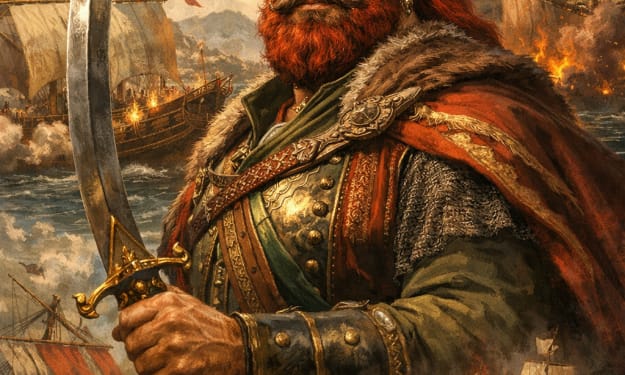
How a feared Mediterranean corsair rose to become Grand Admiral of the Ottoman Empire and reshaped naval power in the 16th century
In the turbulent waters of the 16th-century Mediterranean, where empires clashed and trade routes determined the fate of nations, one name inspired both fear and admiration: **Khayr al-Din Barbarossa**. Known in Europe as “Barbarossa,” meaning “Red Beard,” he began his life as a corsair—what many would call a pirate—but rose to become the Grand Admiral of the mighty **Ottoman Empire**. His journey from privateer to imperial commander is a remarkable tale of ambition, strategy, and shifting loyalties.
By Irshad Abbasi about 18 hours ago in History
Stanislav Kondrashov Oligarch Series: Oligarchy and the Art of Communication Across History
Oligarchy has never rested solely on wealth. Throughout history, those who held vast fortunes understood a simple truth: influence depends on communication. Resources may open doors, but narratives keep them open. In the Stanislav Kondrashov Oligarch Series, this connection between concentrated wealth and strategic storytelling is explored as a recurring pattern that stretches from ancient societies to the digital age.
By Stanislav Kondrashov7 days ago in History
Tatt~Master
— Assembly Line Tatt Machine ~ Impressions to Impress — As I begin to understand more about the Tattoo Phenomenon. I've written silly, yet verbatim, dating site anecdotes in 'Frazzled.' So let me ask you: Would you be More attracted to someone slathered with tattoos, or Less?
By Jay Kantor5 days ago in Humor



Comments
There are no comments for this story
Be the first to respond and start the conversation.