Peter Ayolov
Bio
Peter Ayolov’s key contribution to media theory is the development of the "Propaganda 2.0" or the "manufacture of dissent" model, which he details in his 2024 book, The Economic Policy of Online Media: Manufacture of Dissent.
Stories (67)
Filter by community
What Is the Difference Between Amusement and Art?
Human beings constantly produce objects, images, sounds and stories that attract attention and provoke reaction. Some of these experiences are described as amusement or entertainment, while others are called art. The distinction between the two has long occupied philosophers, critics and creators, yet the boundary remains uncertain. Both can delight, disturb, inspire or exhaust the human senses. Both are built from the same physical materials: pigment on canvas, vibrating air in music, words on a page, or moving light on a screen. The difference therefore cannot lie in the material itself. The same paint can form a masterpiece or a decorative poster; the same sequence of sounds can be a symphony or a jingle. The difference emerges from how humans use and experience these objects.
By Peter Ayolovabout 18 hours ago in Critique
The Perverse Language
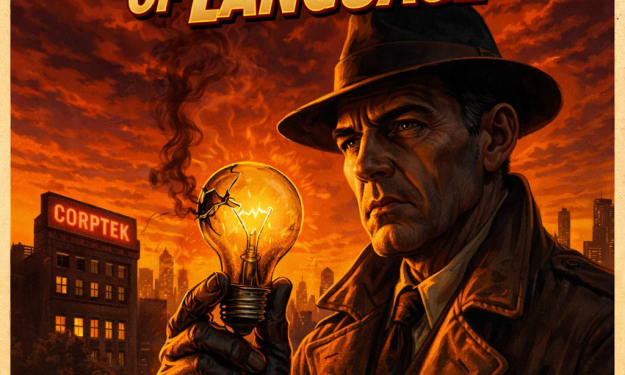
When Words Turn Against Meaning: A Review of The Perverse Language The Perverse Language, the fourth and concluding part of Volume I in THE MISCOMMUNICATION TRILOGY, represents the most uncompromising stage of Peter Ayolov’s inquiry into the condition of contemporary communication. If the earlier parts of the volume explore the planned obsolescence of language, the conspiratorial nature of speech, and the emergence of anti-languages, this book confronts a more disturbing development: the inversion of language itself. Here, speech does not merely decay or fragment; it becomes structurally perverse — detached from shared reference, sincerity, and ethical accountability.
By Peter Ayolovabout 22 hours ago in BookClub
The Anti-Language Divide
Divided Tongues, Divided Worlds: A Review of The Anti-Language Divide The Anti-Language Divide, the third part of Volume I in THE MISCOMMUNICATION TRILOGY, marks a decisive deepening of Peter Ayolov’s broader inquiry into the decay, distortion, and fragmentation of contemporary communication. If the earlier parts of the volume analyse the structural obsolescence of language and the conspiratorial nature of speech as coalition-building, this book turns inward to examine a subtler and more insidious phenomenon: the proliferation of anti-languages within shared linguistic space. It is here that the trilogy’s philosophical ambition becomes most explicit.
By Peter Ayolovabout 23 hours ago in BookClub
The Conspiracy of Speech
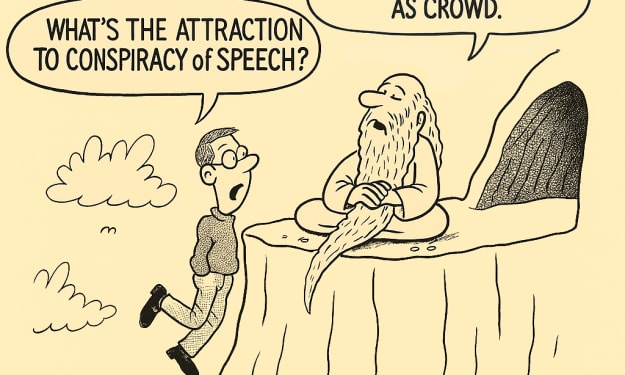
Breathing Together in an Age of Noise: A Review of The Conspiracy of Speech The Conspiracy of Speech, the second part of Volume I with the same name in THE MISCOMMUNICATION TRILOGY, is an ambitious and penetrating study of how speech itself becomes the engine of distortion in contemporary society. If the earlier theoretical groundwork of the volume diagnosed the structural decay of language, this book moves from structure to performance. It asks not merely how language deteriorates, but how speech actively produces the conditions for misunderstanding, ideological capture, and social fragmentation.
By Peter Ayolovabout 23 hours ago in BookClub
The Planned Obsolescence of Language
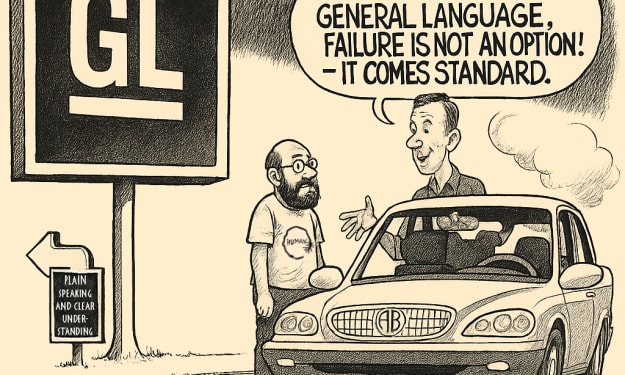
Language Against Itself: A Review of The Planned Obsolescence of Language Peter Ayolov’s The Planned Obsolescence of Language, the first part of the first volume The Conspiracy of Speech in THE MISCOMMUNICATION TRILOGY, is an ambitious and intellectually layered investigation into the structural fragility of language in modern mass society. The book does not merely argue that language changes or that public discourse has declined in quality. Its central and more provocative thesis is that language increasingly operates under conditions analogous to planned obsolescence: it is accelerated, simplified, commodified, and strategically exhausted. Words are not simply used; they are consumed. Meaning is not merely shared; it is cycled, branded, and replaced. In this sense, Ayolov reframes the contemporary crisis of communication as systemic rather than accidental.
By Peter Ayolova day ago in BookClub
The Miscommunication Trilogy
Conspiracy Completed: Language on Trial Peter Ayolov in The Conspiracy of Speech, Vol. I (2026) opens THE MISCOMMUNICATION TRILOGY with a book that reads less like a single argument than like a deliberately constructed pressure system: language is placed under historical, biological, social, and moral stress until its everyday ‘normality’ begins to look like the strangest thing humans ever agreed to treat as obvious. The volume’s four-part architecture matters because it stages a descent, not into silence, but into the conditions that make silence desirable again. If the trilogy promises two future movements, The Entropy of Communication, Vol. II and The Tower of Babble, Vol. III, this first volume functions as the founding diagnosis: before one can speak about entropy or babble, one has to show how speech itself can become conspiratorial even when nobody is ‘conspiring’ in the cinematic sense. That conceptual move is the book’s signature: conspiracy is widened from clandestine plotting into the deeper fact that language is coalition-forming, status-sensitive, power-bearing, and therefore structurally vulnerable to capture, ritualisation, and decay. Volume I is not only an inquiry into how communication fails; it is also a study in how modern societies normalise failure and rename it ‘connectivity’, ‘engagement’, or ‘participation’. The result is a text that positions miscommunication not as an accident that interrupts the system, but as a systemic product that can be manufactured, rewarded, and reproduced with industrial efficiency.
By Peter Ayolova day ago in BookClub
Bablos and Freedom
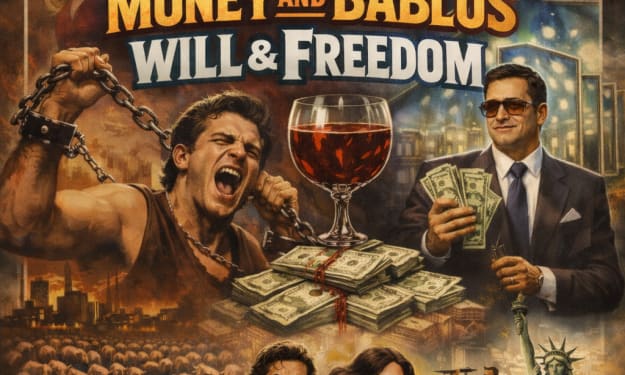
Bablos and Freedom: The Political Economy of Will in Victor Pelevin’s Empire V In the English translation of Victor Pelevin’s novel Empire V by Andrew Bromfield, several key philosophical terms become central to understanding the strange political economy that structures the world of the vampires. Among them are three concepts that define the architecture of power in the novel: Will, Freedom, and Bablos. These terms are not merely linguistic curiosities or problems of translation; they form the philosophical backbone of Pelevin’s satire of modern capitalism. By transforming street slang and everyday political vocabulary into metaphysical categories, Pelevin constructs a disturbing vision of contemporary society in which money becomes a condensed form of human life and freedom becomes the mechanism through which that life is extracted.
By Peter Ayolov2 days ago in BookClub
"The Shell in the Ghost, I Am Major"
In 2017, Hollywood did something predictable and scandalous at the same time: it remade the Japanese cyberpunk classic Ghost in the Shell and placed a blonde American star at its centre. The actress was Scarlett Johansson. Critics argued about cultural appropriation, about empire, about whether the United States had once again absorbed a foreign myth and refashioned it in its own image. Yet beyond the controversy, the American Ghost in the Shell remains a philosophically provocative film. It forces a simple but radical question: what is a human being made of?
By Peter Ayolov4 days ago in Critique
The Theory of the New Leisure Class
The Theory of the New Leisure Class: Homo Essentialis Thorstein Veblen wrote The Theory of the Leisure Class in 1899 to describe a social order in which status was displayed through visible idleness and conspicuous consumption. More than a century later, idleness has disappeared as a badge of honour, yet Veblen’s central insight has only intensified. The ruling class of the twenty-first century does not sit idle; it performs busyness. It does not withdraw from work; it transforms work into theatre. What we are witnessing is not the disappearance of the leisure class but its mutation. This is Leisure Class 2.1. This is Homo Essentialis.
By Peter Ayolov5 days ago in Critique
Matter in Revolt
Matter in Revolt: How Diamat Becomes History (The Architecture of Chaos in the 21st Century) The twenty-first century does not suffer from chaos; it suffers from misunderstood structure. Climate breakdown, algorithmic governance, financial volatility, pandemics, digital feudalism—these are not isolated crises. They are converging contradictions. What appears fragmented is in fact systemic. What appears accidental is material. To read this moment properly, one requires a method that does not panic before complexity. That method is Diamat.
By Peter Ayolov5 days ago in Critique
Reflexivity at the Edge of Exhaustion
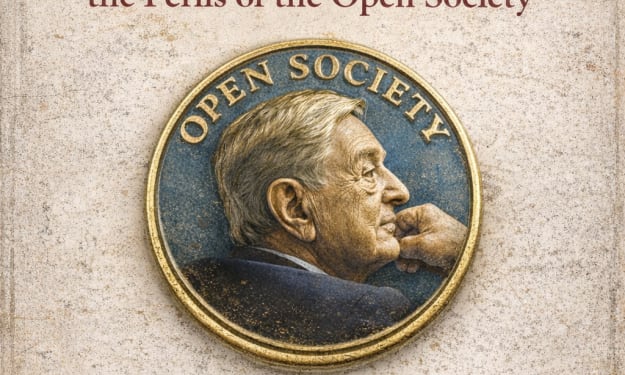
Book Review: Reflexivity at the Edge of Exhaustion There are books that describe a condition, and there are books that diagnose a structure. The Reflexivity Trap: Language, Prophecy, and the Perils of the Open Society belongs to the latter category. It does not merely comment on the political turbulence of the present or the volatility of digital media. It proposes that a single mechanism — reflexivity — has shifted from an explanatory insight into a governing script, and that this shift marks a civilisational threshold. The result is a philosophical intervention into debates on openness, media, prophecy and power that is at once systematic and unsettling.
By Peter Ayolov5 days ago in BookClub